Ephesus and the House of Virgin Mary

After spending a day in the City of Troy and Acropolis in Pergamon, we drove to Kusadasi. Kusadasi is a coastal town developed from old villages and new resorts. We reached there at night and were greeted by a beautiful view of the harbor.

Kusadasi at night

If we thought the night view of the harbor was beautiful, the morning sun reflecting on the rainbow houses on the hill was breathtaking. Unfortunately, the picture below doesn’t do full justice to it, but you can still spot the houses painted in green, blue, purple, and yellow.

Kusadasi in morning

I later found out that the houses on the hill were, in fact, the slum of Kusadasi. The Gypsies settled on the hill a long time ago and started building mud houses. When Kuşadası expanded, the municipality decided to paint the houses (for free) to make them look presentable to the ever-increasing tourists.

There are a lot of Gypsies in Turkey, and they are the citizens of the country. Unlike the Gypsies in neighboring countries, they have the proper paperwork and enjoy the same rights as Turkish people.

Kusadasi is close to the famous old Roman city of Ephesus. Just like Pergamon, Ephesus was also founded by one of the twelve generals of Alexander the Great, Lysimachos, in the fourth century BCE. After his death, it went to the Romans without any bloodshed.

At its peak, Ephesus was the second-largest city in the world and the second capital of Rome outside of Rome. Two hundred and fifty thousand people lived here, which is equivalent to five million people in today’s age.

It is believed that only 25% of those were free. 75% were slaves.

Ephesus is one of the best-preserved ancient sites in the world. The archeological digging at this site has been going on for one hundred years, and still, only a portion of the city has been excavated. 

The Main Street of Ephesus
Roman Fountains

Ephesus has a tem

Ephesus has a temple of Artemis, a Curetes Street, and Roman baths. 

It also has two Odeons and a huge amphitheater with a capacity of 25,000. 

However, the main attractions of the city are the three-story-high library. It was the third largest library in the world after Alexandria and the Acropolis of Pergamon.

Ephesus library
Amphitheater

A

The house of the Virgin Mary

After Ephesus, we visited the house where the Virgin Mary, the mother of Jesus, was taken to after the sacrifice of Christ by Saint John and lived there for the remainder of her earthly life. This Catholic shrine is located on Mt. Koressos, just 7 kilometers away from Ephesus.

The house was discovered in the 19th century following the descriptions in the reported visions of Anne Catherine Emmerich (1774–1824), a Roman Catholic nun and visionary. (Source: Wikipedia)

Although the Catholic Church has never pronounced in favor or against the house’s authenticity, the site is revered by Christians and receives a steady flow of pilgrimage each year. 

I was mesmerized by the serenity of the place. The house was made entirely of stone, was small, just three rooms, and was rebuild in the sixth century. It was rebuilt several times after that to repair the damage caused by earthquakes and weather elements.

It had a baptism pool, natural spring water, and a wishing wall where people tied their wishes.

Although I am not a Christian, nor a religious person, I felt some special energy there. Some places have that spiritual aura about them. This place was one of them. It could be the collective vibes of the pilgrims or the continuous recitation of the bible, and I felt a special connection to the place.

Virgin Mary’s house
Meryemana, the wishing wall

Silk Factory

We stopped by to see the ancient art of uncoiling the silk from cocoons at a carpet gallery on the way back. 

As a part of a well-planned operation to support the local economy (by selling costly handmade carpets to tourists), we were received an army of very polite and welcoming sales assistants.

Many fellow travelers fell prey to their sales tactics. Thankfully both my husband and I could keep our restrain and didn’t buy anything.

Leather fashion house

From the silk factory, we were taken to a leather fashion house. 

There we were treated to a fashion parade in a theatre specifically made for the purpose. Model after model walked the ramp on lively and high-pitched music. 

After the fashion show, an experienced salesman gave a well-sales pitch telling us about the advantage and quality of the garment. The lights were dim. We were tired. But the whole room burst into laughter when one of the guests started snoring in the middle of the speech. 

Village of Sirince

From the planned visit to the carpet and leather factories, we were taken to the old village of Sirince and were given free rein to explore it. It was the best time of the day for me. I explored the ancient jewelry shops where artisans were creating exquisite jewelry items from silver and local stones. We walked uphill on cobblestone alleyways, checking shops, trying pomegranate juice and local ice cream. 

The village dates back to the 19th century and has original white-painted houses. It is known for producing some of the best wines from fruit. In my life, I had not seen the stacks and stacks of pomegranates, quince, and dried figs.

In the evening, we witnessed a breathtaking sunset from our room.

Sunset from our room 

Next week I will write about Pamukkale

City of Troy and Acropolis

After a long tiring day in Gallipoli, we woke up early the next morning and checked out from our hotel in Çanakkale to head for the archeological site of Troy.

If you are surprised that the famous ancient city of Troy is in Turkey, you are not the only one. A history lover, I was astounded and excited to visit the city made famous by Homer’s Iliad and Odyssey.

Even though the weather forecast showed a clear and warm day, it turned out to be a fiercely cold and windy day.

Once we reached the site, our guide Ahmed gathered us and prepared us for what we were about to see. 

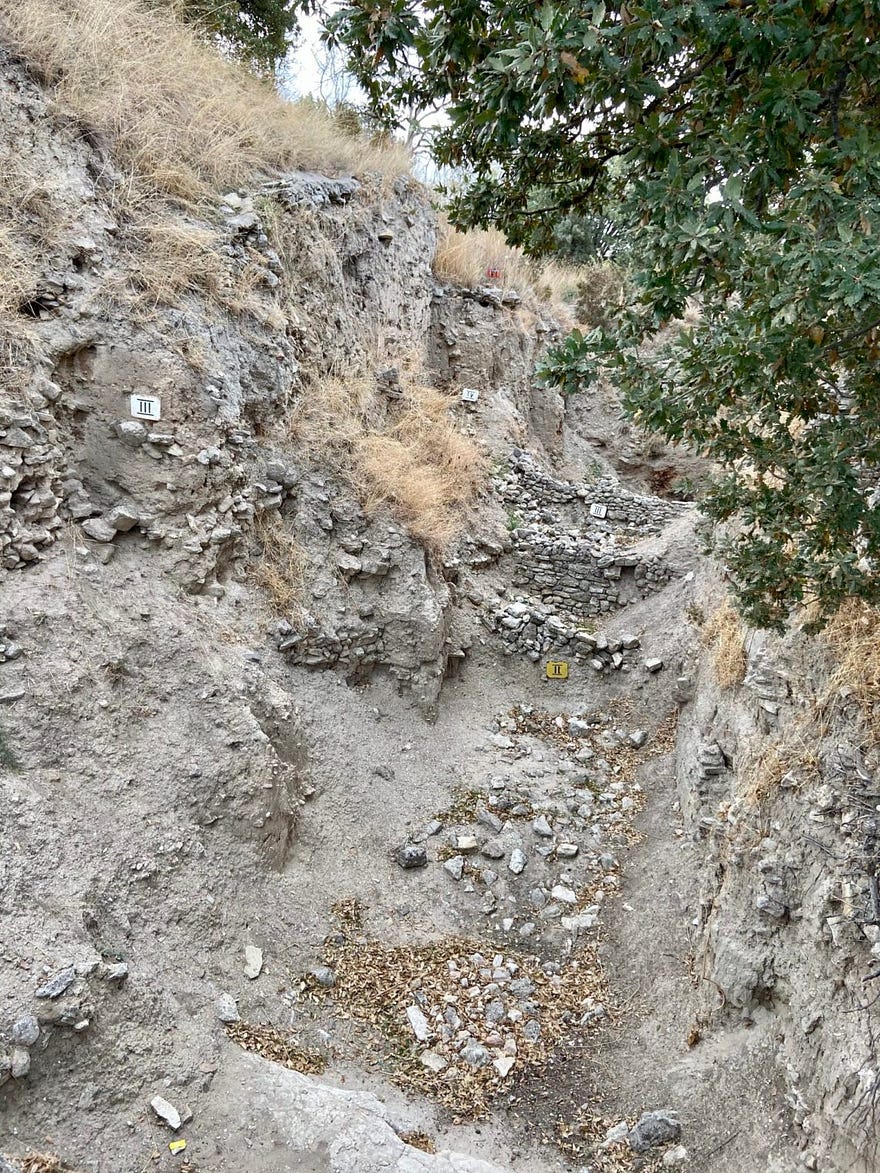
“You all know the story of Helen of Troy and the Trojan horse,” he said. “But you perhaps don’t know that Troy is a 5000-year-old city and was resettled nine times. The excavation shows nine levels of construction of rock and mud-brick walls, built one upon another, making it really confusing to understand which part belongs to which era.”

Image by the author

He continued, “Just to give a context to how old the city was, the story of Helen and the Trojan horse happened during the sixth settlement of the city.”

The little signs with Roman numerals show which era the particular wall was constructed. — Image by the author

It was a massive site. We walked around for more than two hours, witnessing the remains of once a prosperous and important city by the harbor. Many archeologists believe that the city lost its significance when the sea receded. But, there was a time; the harbor was right next to the walled city. We could see from the highest point at the site that the ocean was quite far away.

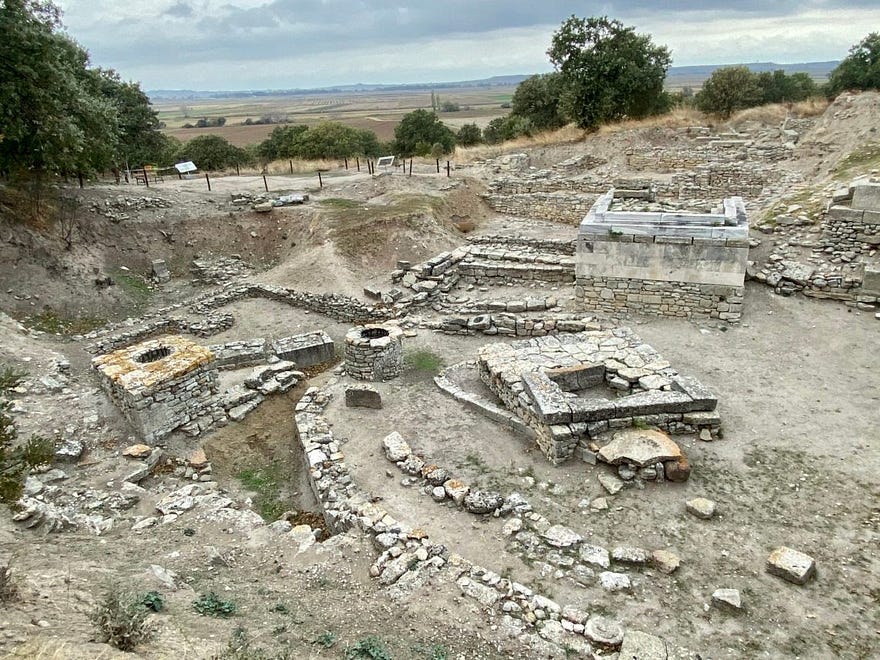
Troy is not only famous for its nine meters high wall but also for its ingenious architecture for collecting and distributing water and heavy war machinery. 

Water cisterns at Troy — Image by the author
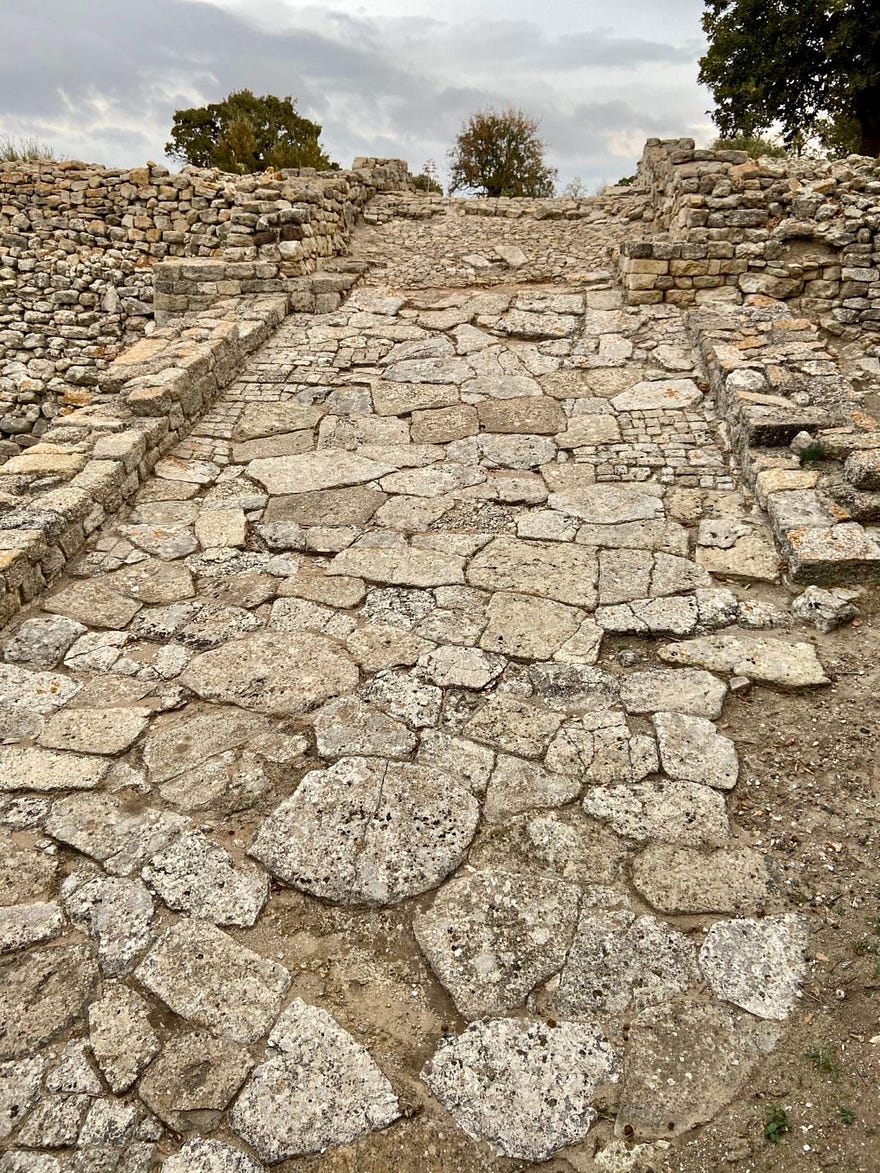
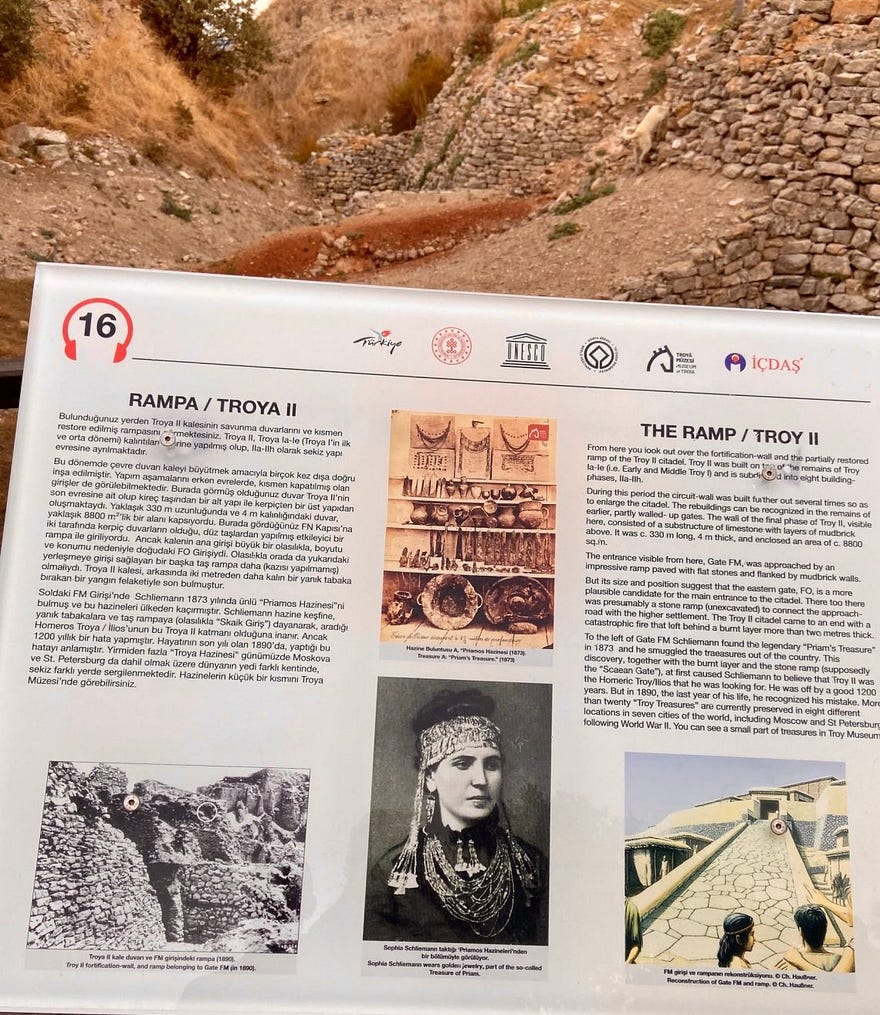
The Ramp of Troy to get to the interior of Troy II. The city was protected by high walls, around 330 meters long, surrounding about 9000 square meters.— Image by the author
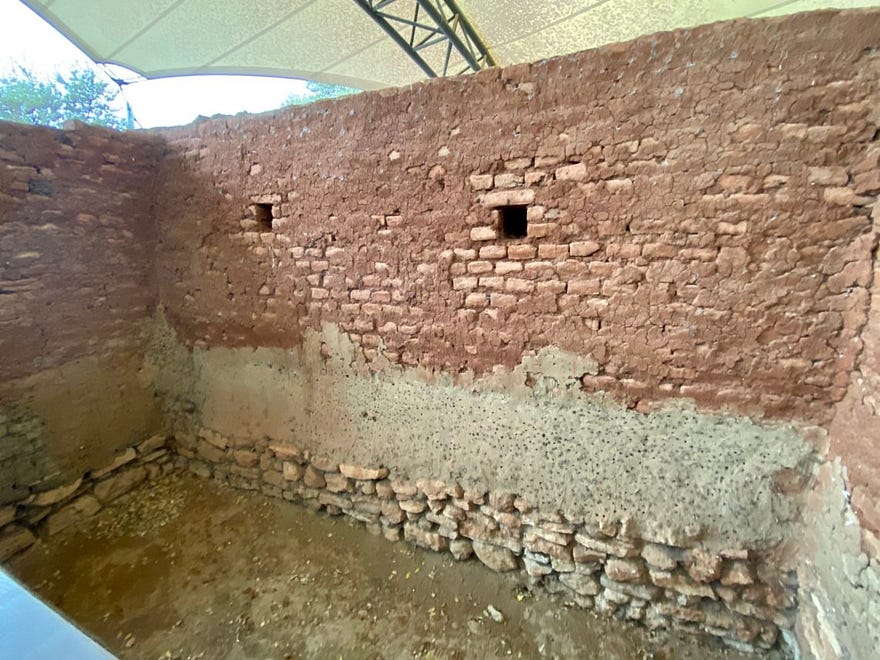
Two layers of the wall. The lower part made of rocks was built during the first settlement in Troy. The upper part is made of mud-brick was built during later settlement. — Image by the author

Interesting Story about the discovery of Troy

For a long time, the city of Troy was believed to be a mythical city until a German treasure hunter found it with the help of locals. 

Even when he was a child, Heinrich Schliemann was fascinated by the story of wooden horses and soldiers hiding in it. He believed that if the Trojan war really happened, the people wouldn’t have had the chance to move the treasury. Since the Greeks didn’t find any treasure, that means it was still there somewhere. His persistence paid off. He found the city of Troy but no treasure. 

Schliemann did find some gold jewelry but not from the Helen of Troy period but 1200 years before that.

Treasures discovered from the site are now in nine different museums globally, including the St Petersburg of Russia.

The site was well-signposted. This sign showing a lady wearing the treasure found at the site. — Image by the author

While researching for this article., I found another interesting fact—this time about the lady in the signpost.

When Schliemann decided to search for Troy, he realized that he would need a personal assistant with knowledge of Greek history and culture. He even put an advert that he was looking for a wife in an Athenian newspaper. His bride was a relative of the Archbishop of Athens. Her name was Sophia Engastromenos, and when 47-year-old Schliemann married her, she was only 17. Her best-known photo shows her wearing the ancient treasures discovered by Schliemann at Troy. The marriage had three children with highly symbolic names: Andromache, Troy, and Agamemnon. 

Source: Turkish Archeological News

Trojan Horse

There was a large model wooden horse to imitate the famous Trojan Horse on the way out from the site. It didn’t look authentic, but it was fun to go inside and have your photo taken from outside.

Drive to Pergamon

Pergamon was a place where Greek and Turkish lived side by side for centuries. Only recently the final exchange of people happened between two countries.

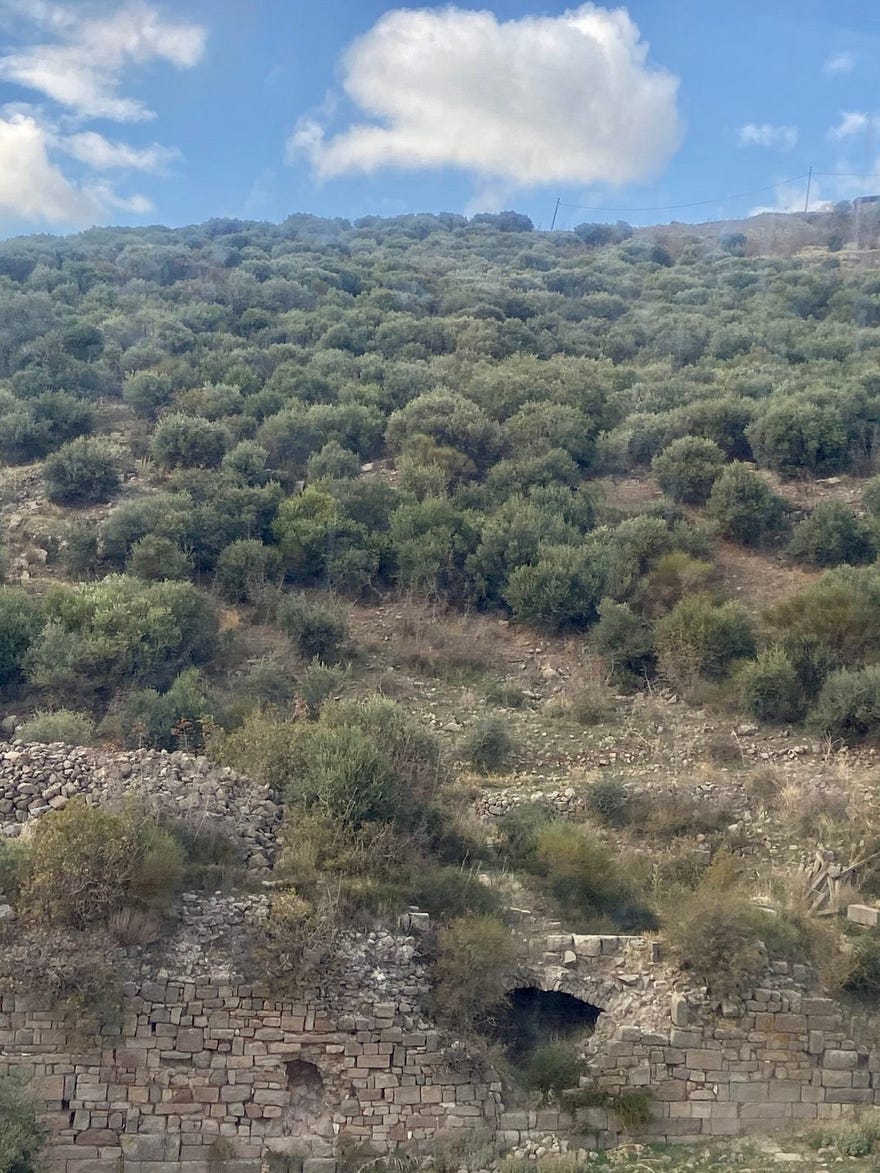
The drive from Çanakkale to Pergamon was scenic, to say the least. On the right-hand side was the Aegean Sea, while on the left was the mountain range covered with native olive trees. 

The Olive trees are to the Mediterranean like the Eucalyptus trees are to Australia. They grow by themselves. Their average life span is 400 to 500 years. Did you know that the oldest tree in the world is an olive tree that is 2000 years old?

The trees are kept fresh by cutting off the top and grafting it with a younger tree.

Image by the author

The northwest region of Turkey, known as Anatolia, is the summer destination for Turkish people. Small towns peppered the whole area with holiday houses owned by rich and middle-class Turkish families. These houses are occupied just for three months of the year. It is quite common for the older middle class of Turkey to own two houses, a primary home and a summer house or a village house.

We also crossed a number of cotton fields. The textile industry is providing a livelihood to many people, and Turkish cotton is quite sought after.

Acropolis of Pergamon

After lunch, we drove to Pergamon Hill to visit Acropolis, a Greek city established by one of the generals of Alexander the Great. It is 2200 years old city and is a bit better preserved than Troy.

Pergamon’s ancient name was ‘Pergamos’ which means “people of the high city.” It is situated on a hill, and we reached there through a cable car.

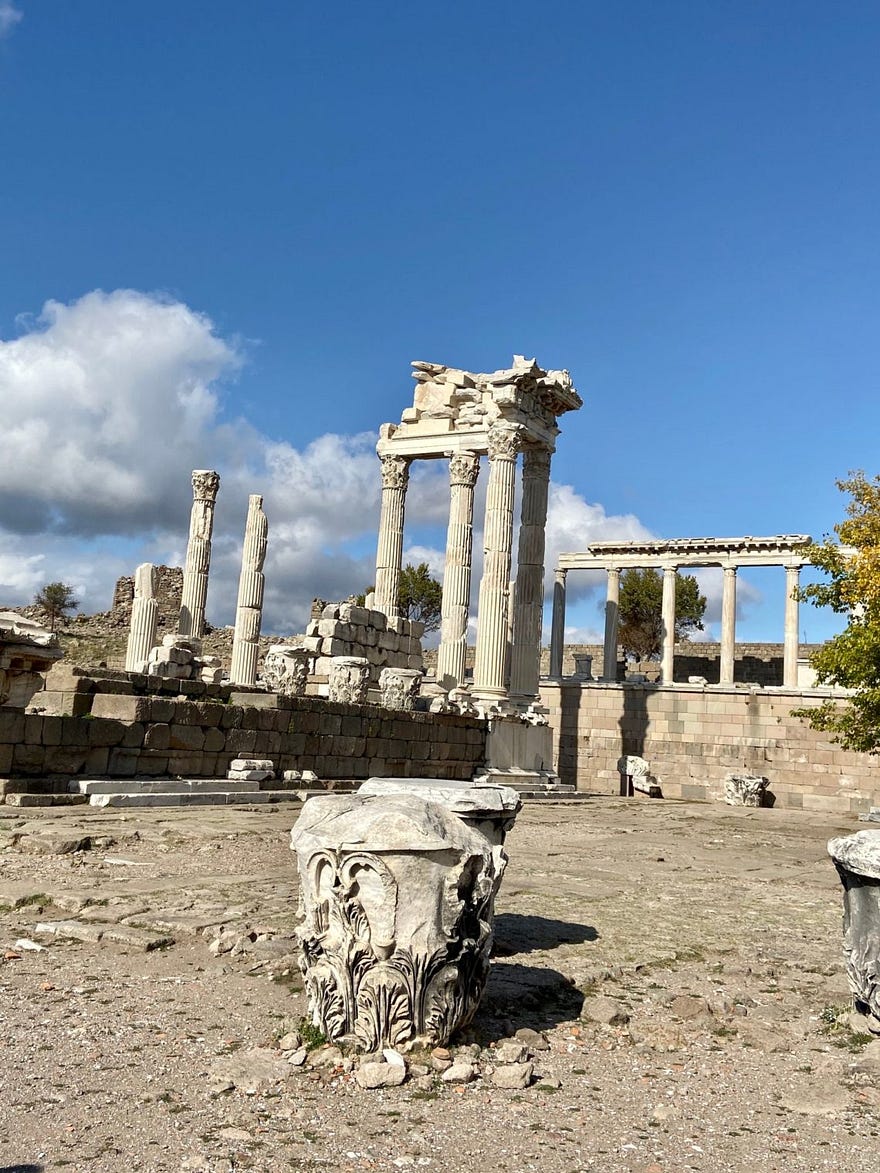
With its impressive temples and library Acropolis was a big cultural hub in its heydays. Its library was the second largest in the world after Alexandria. 

We learned Mark Antony gave Cleopatra a substantial number of volumes from the Pergamon library to replace those destroyed by the fire at Alexandria Library, quite possibly because the fire that consumed the library was started on orders by Julius Caesar to burn his own ships in Alexandria harbor as a tactical ploy.

Walking through the ruins makes history come alive. All those historical figures (Helen of Troy, Mark Antony, Cleopatra), which I thought were just legends, were real people who lived in cities and houses just like we do now. It made me appreciate how our actions are judged even thousands of years later.

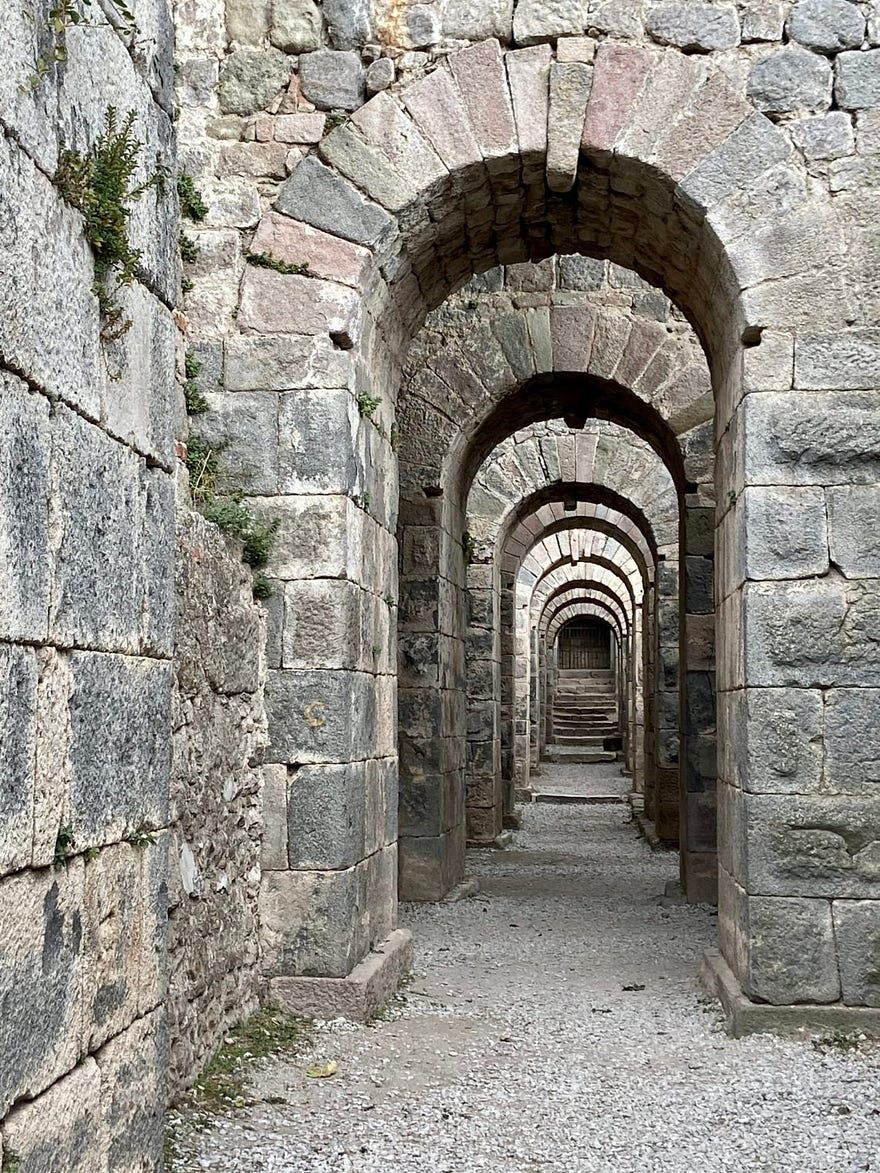
And our creations survive much longer than us. Look at this beautiful archway at the citadel. Unlike today, people made things to last in those days. 

Image by the author
Image by the author
Image by the author
Lake around Acropolis – Image by the author

The acropolis is surrounded by water but to get it uphill. The inhabitants used ingenious ways. They made aqueducts and used the force of water to bring it to the acropolis.

After the death of the last Greek general, Pergamon was passed on to Romans without any conflict. However, Romans didn’t like its location. Mainly because Pergamon was not a harbor city. Roman slowly abandoned Pergamon and moved to Ephesus. 

I loved visiting both the sites. But I didn’t know a bigger treat awaited me the next day. We were going to visit Ephesus.

Gallipoli – the futility of war

After covering Istanbul in a day, we left early the next morning for Gallipoli battlefields. We had the whole bus to ourselves. With just 21 of us in the group, we had plenty of room to spread. The best part was that the bus had Wifi, which meant I could write and publish on my blog during the ride from one destination to other. 

On the way, we stopped at Eceabat to have lunch. Eceabat is a small town in Çanakkale Province in the Marmara region. There was a bit of time for the lunch to be served, so we decided to take a walk. Right next to the restaurant, a big part of the seashore was converted into a memorial. It prepared us for what we were going to see. 

Memorial at Eceabat — Image by the author

We checked in a hotel near Canakkale and, after a brief rest, headed for the Kabatepe Museum.

I must mention here that both my husband and I were not too keen to visit the battlefields. Unlike the rest of the Australians in the group, we didn’t have any connection with WWII. We would have rather spent an extra day in Istanbul. 

We walked towards the newly built complex of Kabatepe Museum half-heartedly. As we walked the gallery after gallery, looking at the weapons, ammunition, uniforms, photographs, letters written by the soldiers to their loved ones, and watching the movies, something started emerging for us. 

For the first time, we learned the other side of the story. For years we have been hearing the stories of tens of thousands of Anzac dying at Gallipoli in a single day. We live in Canberra, and we have a War Memorial in our city we proudly take all visitors to see. It tells the story of the Australian who died thousands of miles away from home.

But thousands of Turks died too. And they were defending their country. Their soil. Their fields. For the first time, we heard the stories of their heroism, their sacrifice, their bravery, and their humanity as well.

Anzac Cove

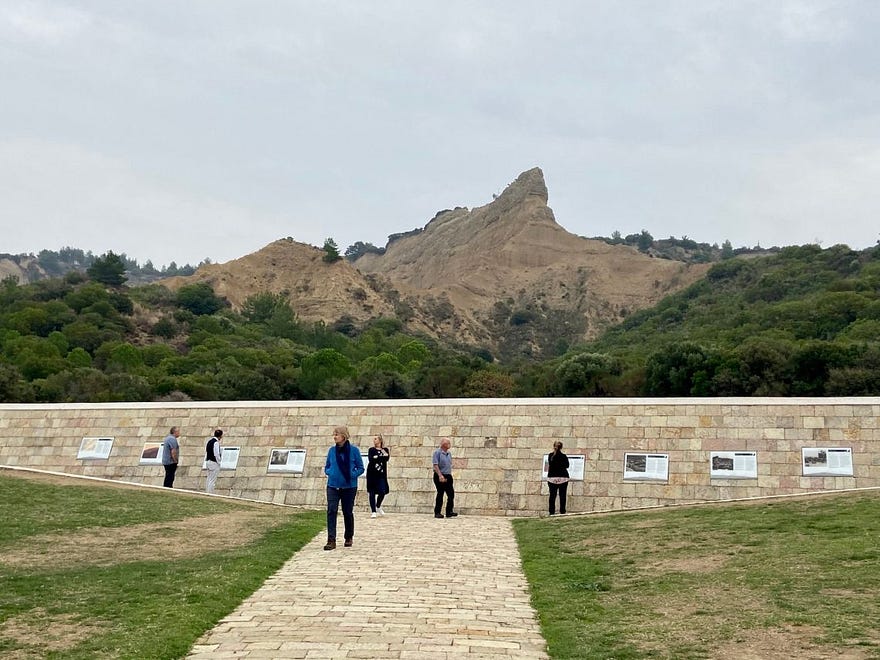
From the Museum, we drove to the Anzac Cove. Anzac Cove is where the Allied Forces landed and realized their mistake. They had landed at the wrong spot. There was not enough ground to dig trenches. Instead, it was a tiny area immediately guarded by a hill where the Turkish soldier was waiting for them. 

As we got off the bus, a deadly silence greeted us. For some reason, none of us made a sound. We walked softly, talked quietly, and just took in the ambiance of the place. Needless to say, we were moved beyond words.

ANZAC Cove, see the high cliff in the background — Image by the author.

The whole area is covered with cemeteries. We went to Ari Burnu Cemetery, Beach Cemetery, Shrapnel Valley, and Plugge’s Plateau.

At some places, the Turkish and ANZAC trenches were just eight to ten meters apart, and during the ceasefire, the soldiers would exchange cigarettes, chocolates, and beef.

It is not widely known that Turkey suffered much heavier casualties than the ANZACs.

The Gallipoli soil is littered with the graves of soldiers from both sides. So much so that the Turkish Government has declared the area a national park and forbidden any digging even for building roads in case they disturb a resting soldier.

Image by the author
Image by the author
Turkish Memorial — Image by the author
Turkish Memorial — Image by the author.

I was surprised at how much the visit to Gallipoli had affected me. Perhaps it was the visit to the museum beforehand that made the visit very poignant. 

The most heartwarming thing we saw in all that dread of death was the Turkish president Ataturk’s letter to ANZAC mothers, which is displayed amidst the graveyards to remind everyone how futile the war is.

Turkish president Ataturk’s letter to Australian mothers — Image by the author.

But More Heart Wrenching Was Still To Follow

Heavy-hearted, we departed Gallipoli to Çanakkale. On route, we sat on a ferry to cross a small stretch of sea in between.

We were sitting on the ferry having coffee when a young boy interrupted us with a silly smile on his face.

“Are you from India?” He asked in Hindi. He was perhaps not even in his twenties. I wouldn’t say I liked his way of trying to make acquaintance with us. I thought he was overly friendly.

“Yes.” It was a futile question as we looked like Indians and are from India. I didn’t elaborate that though we were Indians, we lived in Australia for more than three decades.

“How is India?” A stupid question.

“Fine.” I gave the obvious answer in a flat tone. It was meant to end the conversation. But, unfortunately, I was still sullen and not in a mood for small talk. 

But I felt bad at my own rudeness and asked him, “Where are you from?”

“Burma.”

“Oh really, we have been to Burma. From where in Burma are you from?”

“Arakan.”

“Oh! Did you come here to work?”

“Yes, I work in the cafe here.”

“And where is your family?”

“I have no family. They killed them all. My parents, my brothers, my cousins. I am alone in the world.”

It was as if he punched me in the heart. Here he was, a causality of war right in front of us, and I was being upset with him to interrupt me from my somber mood over the deaths a century ago.

All wars that cause innocent people’s death are futile, whether they are civilians or soldiers. The Rahinga boy was made an orphan for a futile reason too.

We can only hope that one-day humanity learns its lesson and start living in harmony. If it can do that, there are enough resources for everyone.

Istanbul in a day

The three-country packaged tour of Turkey we are doing had only one day for Istanbul, which was really disappointing. Istanbul was on my list for a long time and I wanted to see all the main attractions.

It turned out that with a bit of prior knowledge and planning, you can cover a lot in a day.

Most of Istanbul’s attractions are concentrated in one area. They are within walking distance, which makes it easier because by walking you can avoid traffic jams in old Istanbul, which can have you stranded for hours.

Our group had 21 members and we were all staying in the same hotel. After a good night’s rest were are all eager to get started. Ahmet, our guide picked us at nine. Driving through the morning crowd we headed straight towards old Istanbul. 

We got off the bus near the Blue Mosque and walked through the alleyways to Sultanahmet Square. ( I wrote about three columns and Blue Mosque in my post, Istanbul — The City of 3200 Mosques).

The entry to the Blue mosque was just next to the columns. We managed to get in before the prayer time. Unfortunately, the mosque was going through major restorations. As a result, only a quarter of the interior was visible. 

Whatever was visible was exquisite.

First of all, you have no idea how big the interior is from the outside. Second, it is hard to fathom the beauty of the intricate design. Each panel, each pillar had different designs and yet they all blended so well with each other. 

We spent a good half an hour inside taking photos, reading the information, and admiring the walls and ceiling artwork. I managed to find a corner without any tourists to take a picture. But even the picture can’t capture the true beauty and serenity of the place.

Right next to the mosque is the Hagia Sophia. 

Hagia Sophia was built in 537 by the Byzantine Emperor Justinianus. It used to be a church in the golden age of Byzantine. In the 15th century, it was converted into a mosque. Then again in the twentieth century, it was converted into a museum and now holds the Christian and Muslim relics side by side. 

Unfortunately, there wasn’t enough time for us to go inside. The queue was long and you need at least an hour and a half inside. We discovered that there was a fast lane available if we were willing to pay extra. But we decided to keep it for our next visit to Istanbul.

At about five minutes’ walk from Hagia Sophia is the Topkapi Palace. 

Topkapi Palace was a residence of Ottoman Sultans for 350 years. For more than three centuries it was the seat of supreme executives and judiciary council until the 17th century when Topkapı gradually lost its importance. 

The sultans of that period preferred to spend more time in their new palace the Domabahce Palace along the Bosphorus. In 1856 Sultan Abdulmejid moved his court permanently to the new place and Topkapi became the imperial treasury, library, and mint.

We entered the palace through the Cannon Gate, (the literal meaning of Topkapi is cannon gate)and were greeted by the first courtyard. Some of the trees there are hundreds of years old. 

The palace complex has four courtyards and many smaller buildings. Although the palace has hundreds of rooms and chambers I didn’t find it intimidating or overpowering. The buildings are scattered and low-key. 

It has four main areas:

  • the ministers meeting place, which has expensive antique watches and weapons are on display; 
  • the museum for holy Islamic and Jewish relics; 
  • the newly opened library and 
  • Ottoman kiosks where ministers used to entertain. 

The longest queues were at the museum. But luck was favoring us. When we reached there the lines thinned. We were able to spend a good amount of time looking at the relic. The crowding drawing replica was Moses’s shaft. 

The wooden shaft kept under a lot of security is said to be the one that Moses used in his later years.

Outside gardens provided relief from the crowds. Two horsemen gave a nice touch to the antiquity of the palace.

By this time, we were starving. Ahmet made us walk through the streets and took us to the cobbled alleyways of inner Istanbul. 

He had a treat in store for us. We were dining at the famous restaurant ‘By Kinyas.’ The whole restaurant was booked for us. We sat on the rooftop and had beautifully grilled fish with salads. Turkish dips and salads are something to die for. Creamy but light, flavorsome but not spicy.

Speaking of spices, our next stop was the Spice Market, also known as the Egyptian Market. 

The Spice Market is an indoor market with impressive archways. It has 86 shops, mostly selling spices, jewelry, and souvenirs. 

Each shop had an army of young men recruited to lure tourists to come inside the shop. But they are very friendly and polite. There was no pressure selling; instead, you are offered free pomegranate tea and Turkish delights. 

An Arminian guy charmed us so much that we took photos with him and promised to see him if we came to Istanbul again.

The Grand Bazaar is similar to the Spice market and has more than 4000 shops. Again we did have enough time to go to the Grand Bazaar. That is something I have added to my next trip to Istambul.

After the Spice Market, we came back to the hotel for a short rest. At seven-thirty Ahmet picked us up again for a Bosphorus dinner cruise. It was the perfect finale for the day. A food and dance spectacle spiced with the light show of the building along the Bosphorus strait.


Although my husband and I were a bit disappointed that the packaged tour had only one day for Istanbul, we were able to cover a lot within a day.

That doesn’t mean I will not go back there. Istanbul is one place I want to spend more time to really enjoy it. And when I go there next time I know exactly where to head first.


That was Istanbul in a day.

Next week I will write about Gallipoli.

Istanbul – The city of 3200 mosques

Ahmed was fourteen years old when he became the sultan of Turkey. His father died at a very young age. Aware of his own mortality, he decided to build something to be remembered for.

He called his chief architect and asked him to design a mosque with gold minarets. Unfortunately, the architect took his instructions a bit wrong and designed a mosque with six minarets. The pronunciation for the word ‘gold’ and ‘six’ are almost similar in the Turkish language.

He could have his head chopped off for that mistake but lucky for him that the Sultan liked the idea of a mosque with six minarets.

Usually, a mosque has two or four minarets; a mosque with six minarets was unheard of. Also, it was less expensive to build than gold minerals. 

So the project went ahead. 

The Mosque was built in a record time (in less than seven years), and the emperor died a year after aged twenty-six.

It turned out to be a good idea after all, because the mosque young Sultan Ahmed build is now the most famous mosque in the world.

Image by the author.

It is known as The Blue Mosque. But only by the outsiders. 

Turkish people know it as the Sultanahmet Mosque.

Istanbul has 3200 mosques.

Contrary to popular belief, The Blue Mosque is neither the oldest nor the biggest mosque in Turkey but is undoubtedly the most famous and the most beautiful one.

It got the name The Blue Mosque because of its blue interior.

What I found even more impressive than the mosque were the columns just outside the mosque:

  1. Constantine’s Column
  2. The Serpent Column
  3. Egyptian Column

Constantine’s Column

Erected by Emperor Constantine in 330 C.E., this column was constructed from 8 separate columns. Each column weighed three tons and measured three meters in diameter, which were placed one on top of another. 

It used to have the Emperor Constantine statue at the top, but it was struck by lightning in 1081 C.E. It used to be all covered in bronze.

Constantine’s Column

The Serpent Column

The Serpent Columns was brought from Delphi. It has three snakes coiled around each other. The heads of the snakes are broken; one of them is in the British Museum.

The Serpent Column

Egyptian Column

This 3500 old obelisk was originally set up by Tuthmosis III of the 18th Dynasty of Egypt in 1450 BC, along with a similar one in front of the Temple of Amun-Re at Karnak.

Inscribed on the obelisk is hieroglyph script, still clearly distinguishable. The script reads that it was his father’s honor that Tutmoses erected an obelisk at Karnak and a monument in Mesopotamia. Depiction of the Pharaoh and Amun-Re are also featured on it.

Several obelisks were transported from Egypt to Rome. Constantine displaced it from Rome to decore his new capital. But for some reason, the delivery took a long time. The obelisk didn’t get re-erected till the reign of Theodosius I. 

Egyptian Column – A 3500 old column was brought from Egypt. Because of its weight, only half of it could be brought.

Next post – how to see Istanbul in one day.

Airports – the new galleries for contemporary art

Airports have come a long way in the past few years.

With their massive atriums, seemingly endless corridors, and captive travelers, they are the perfect venues for contemporary art installations.

Traveling is stressful. Art combats boredom, frustration, and stress. It can provide a welcome distraction for those with delays or those waiting in an endless security line.

The above massive indigenous art is on display at Sydney International Airport.

The Hamad International Airport at Doha, Qatar’s capital, has got eleven artworks on display in collaboration with Qatar Museums.

Artwork at Doha airport
Massive Wooden Pinocchio statue at Doha airport

It is great to see that airports and the museums working together in transforming airports into an immersive exhibition space to showcase the works of locally, regionally and globally renowned artists with the ultimate desire to enrich the overall traveling experience by making art more accessible for everyone.