What does a crockpot have to do with storytelling

Irving Naxon, the inventor of the crockpot, once revealed the inspiration behind his invention.

His grandmother grew up in a small village in Lithuania. Each Friday, her mother would send her to the local bakery with a pot of uncooked “cholent” to be put in the oven. The pot would sit there for the whole day. While the family observed the Sabbath, the dying fire of the oven would cook the stew. At sundown, she will bring back the pot and the family would have the steamy delicious stew for dinner.

That simple story stayed with Naxon for the rest of his life. He wanted to prepare the same kind stew but in the convenience of his home. He figured out a way to create a heating element that surrounded the pot in the same way it would surround an oven in a bakery. His invention was not only easy to use but also consumed less electricity. And it didn’t cost much. He called his invention ‘Naxon Beanery.’

Naxon Beanery later named the crockpot is central to western cooking. A simple story told by his grandmother led to change the western culinary history forever.

Stories have power to inspire.

Before TV, before internet, before mobile phones, stories used to be the medium to pass knowledge from one generation to another.

Religion, society, culture, families all used stories to teach values, develop character, and provide inspiration.

As human beings, we are automatically drawn to stories because we see ourselves reflected in them. Stories illustrate the point much better than facts or explanations can. Through stories, we share passions, fears, sadness, hardships, and joys. Stories are central to our communication.

We engage with others through stories. Storytelling is a lot more than just a recitation of facts and events. Stories convey meaning and purpose that help us understand ourselves better and find commonality with others.

Stories are all around us.

Every event can become a story. The reason we don’t see the story in everyday happening is because we don’t slow down to draw the lessons from our mishaps or admire the beauty of the opportunities that came our way. In today’s fast-paced environment, there is no time to reflect on our experiences and to build a narrative out of them.

There is the reason why children are so well engaged in storytelling. Kids can’t wait to hear a good story because they’re naturally curious and want to learn more about the world.

For centuries, stories have been used to pass on knowledge, and when important teachings are embedded in a story, we embrace that information uniquely because we tend to remember the underlying emotions in a story rather than the actual elements of that story.

As writers, we struggle to figure out what to write.

We start thinking that our job is to constantly bombard our readers with new information. We tend to forget that people don’t need more information. They don’t need to be taught either. They need to be touched in their hearts. They need stories. Stories of people, places and things.

Well-told stories are a gift from a writer to his readers. Here, is one from story from Sidney Sheldon’t memoir The Otherside of Me:

At the age of seventeen, working as a delivery boy at Afremow’s drugstore in Chicago was the perfect job, because it made it possible for me to steal enough sleeping pills to commit suicide. I was not certain exactly how many pills I would need, so I arbitrarily decided on twenty, and I was careful to pocket only a few at a time so as not to arouse the suspicion of our pharmacist. I had read the whiskey and sleeping pills were a deadly combination, and I intended to mix them, to make sure I would die.

It was Saturday – the Saturday I had been waiting for. My parents would be away for the weekend and my brother Richard was staying at a friend’s. Our apartment would be deserted, so there would be no one there to interfere with my plan.

At six o’clock, the pharmacist called out “Closing time.”

He had no idea how right he was. It was time to close out all the things that were wrong with my life. I knew I wasn’t just me. It was the whole country.

I read this story when I was seventeen years old. It has stayed with me for forty years. I can’t say the same about the articles I read both online and in print.

In today’s world with easy access to high-quality content, people don’t want you to give them more things to think about, more stuff to do, more clutter to fill their minds. There is an ocean of self-help articles. YouTube videos are screaming for attention with headlines such as – “You are missing out if you don’t do this routine.”

In such an environment, if you can tell a simple story in your authentic and honest voice, your writing will have much more impact. It will stay with more people, much longer than the screaming YouTube video or a mile-long self-help listicle.

When someone writes something that doesn’t tell me what to do but instead shares their honest perspective and personal story in an authentic voice they touch me.

They inspire me to become the kind of storyteller Naxon’s grandmother was, whose simple ‘stew-making’ story inspired Naxon to invent a simple device but which had a profound impact on the lives of millions.

Photo by Edgar Castrejon on Unsplash

How to shed a “dabbler’s mindset” and develop an author’s mindset

Imagine that you are in year twelve, and the Education Board decides to introduce entrance test to Medicine School. You are to be tested on four subjects in a single three hours test. You are to recap two years’ worth of Zoology, Botany, Physics, and Chemistry in a day.

It-can’t-be-done,’ you would think. Wouldn’t you?

That is what I thought too.

So strong was my conviction that I thought none of my friends would be able to do it either. I was certain we were all going to fail. And no one will get a seat in Medicine.

Guess what happened?

All of my friends got through, except me.

It was not that I wasn’t bright; I was one of the top students in the class, having topped the district in years nine and ten.

I had the capability. What I didn’t have was the right mindset.

What is the mindset?

Mindset is the mental attitude that determines how we interpret and respond to situations.

It plays a critical role in how well we do in life. Although the word “mindset” is considered relatively new, having first been used in the 1930s, its evidence is as old as human history itself.

From the cave days, humans had a curiosity mindset. We want to learn about everything, and we want to figure out how things work.

Soon humans developed a problem-solving mindset. That is the reason we have advanced from living in the caves to living in air-conditioned houses. We have cars to move around and planes to fly.

Quiet recently, Stanford psychologist Carol Dweck discovered that humans have a growth mindset and a fixed mindset. When faced with a challenging problem, the fixed mindset people think is impossible to solve and give up before starting. While the growth mindset, people view it as a challenge and tackle it as a learning opportunity.

Then there is the “dabbler’s” mindset.

What is a “dabbler’s” mindset?

People with “dabbler’s‘ mindset will dip their toes in the water but have no intention of jumping in and swimming to the other end.

I couldn’t get through the entrance exam because I didn’t approach it with the mindset of a person who is going to succeed. Instead, I approached it with the “dabbler’s” mindset.

The“dabbler’s“ mindset is what most of the newbie writers have as well. They want to start writing their book and see how they go. They have no plan, no preparation, and no deadline in mind.

What is the author’s mindset?

For an author, every book is a project. He prepares an elaborate plan to finish the book. Just like a project manager, he uses spreadsheets to monitor the progress of his book.

He knows he has only a certain amount of time to finish it.

He knows that if he needs certain information to include in the book, he will have to research it and find it in that finite time.

If he lacks any skills to write his book (whether it is fight scenes between martial arts fighters or trading in bitcoins), he doesn’t put his hands up in the air and say “too hard” and give up. He learns everything there is to learn about it and gets good at it to come across as a novice when he uses it in his book.

Can we develop an author’s mindset?

“Writing is a process of dealing with not-knowing.” — Donal Barthelme.

The not-knowing is crucial to art that permits art to be made. But that doesn’t mean your approach to writing should be of not-knowing too. You got to known where you are going, how you will get there, and what steps you will follow to write a book.

There are three distinct attributes that you need to develop if you want to stop the “dabbler’s” approach and write like an author:

1. Begin with an end in mind
2. Map the route
3. Build a system

1. Begin with an end in mind

Nothing is more important for an author’s mindset than Stephen Covey’s Habit # 2 — Begin With An End In Mind.

When you start a book (or even an article or a short story), think where you want to take it. By that, I don’t mean how it will end but what you want to do with it. Who will be the readers? How long will it take you to write it? How many revise? How will you edit it? Will you do it yourself, or will you hire the services of a professional editor? Will, you self-publish it or go the traditional publishing way?

I know many writers who are stuck in the first draft of their book because they haven’t planned what will happen when they finish. That is why they will never finish their book. It becomes their default position.

Writing a book is not just a wishful thinking; rather it is astute planning to ensure that you accomplish what you started.

That takes us to the next attribute.

2. Map the route

Let’s say you landed in New York and hired a car. Would you hop in the car and start driving, or will you turn on the GPS, enter the hotel address and let it map the route. Even if your hotel is not far from the airport, you still know you will be driving around in circles and waste too much time.

You need to map the route to take your book to the finish line and then get it published. Each one will have its own milestones, its own checkpoints, and its own deadlines. Then you will find the same with your next book.

Successful authors don’t just think about one book. They think way beyond the book they are writing. They write a series. Several series. To be able to do that, you are going to need a system.

3. Build a system

Systems get things done efficiently and effortlessly.

The beauty of a system is that it takes you from conscious mode to autopilot mode where you don’t have to think. You brush your teeth each morning on autopilot mode. What if you write a book like that. Your system can help you do exactly that.

Writing 80,000 words book in a year is hard. But writing 800 words a day is easy. An average person can do it in 40 minutes. Your system will ensure that you write those 800 words every single day without fail. If you do that, write the book in 100 days, leaving you 265 days to do revisions and publication. That is efficiency. You are only writing just 40 minutes a day. That is effortlessness.

Is there any guarantee that you will succeed?

There are no guarantees in life. Yet, the right mindset wins half the battle; preparation wins the other.

The right mindset will ensure that you prepare for the whole journey. You will not only carve the whole path, but you will have a way to get there too — your system. And you will form habits for writing future books as a mindset is nothing more than the habits of the mind formed by previous experience.

Whatever you do, don’t develop the “dabbler’s” mindset. The one I developed when I failed to secure a seat in Medicine. I told myself that I didn’t want to become a doctor anyway. I thought there were better careers than spending your life among the sick people.

But the truth was my “dabbler’s” mindset let me down. It attached a stigma of “failure” to my name, which took me decades to overcome.

You don’t want that to happen to you. Do you?

Photo by Hello I’m Nik ? on Unsplash

[mc4wp_form id=”138″]

Are you prepared for your Authorpreneurship journey

In 1975, Junko Tabei became the first woman to climb Mount Everest. She was considered a frail child, but nevertheless she began mountain climbing at the age of ten, going on a class climbing trip to Mount Nasu. Although she was interested in doing more climbing, her family did not have enough money for such an expensive hobby. Junko made only a few climbs during her high school years. But the idea of climbing took hold of her.

After graduation, once again she returned to her passion. She joined men’s climbing clubs in Japan. While some men welcomed her as a fellow climber, others questioned her motives for pursuing a typically male-dominated sport. Nonetheless, she learned the skills and built her stamina. Soon she climbed all major peaks in Japan, including Mount Fuji.

Seven years later, in 1969, she established women’s only Mountaineering Club. Her women-only team successfully climbed many mountains in Nepal including formidable Annapurna.

Yet it took her another six-years to lead an expedition to Mount Everest. In that expedition, when her team was camping at 6,300 meters, an avalanche struck. Junko and four of her fellow climbers got buried under the snow. Tabei lost consciousness until sherpa guides dug her out. Even that mishap didn’t stop her. She continued climbing and reached the top.

In a way, Authorpreneurship is like mountaineering.

The idea to make a living with your writing takes hold of you. You become desperate to write. You write some articles, publish some stories and even start a blog. But what you really want to do is write bestselling books. That would be equivalent to planning your own Mout Everest expedition. It will take you years to get to that stage. Like mountaineering, authorpreneurship demands a lot of preparation.

What is Authorpreneurship.

If you are not familiar with the term, don’t fret. I invented it. It stands for all those twenty-first-century writers who build themselves a significant career as authors using online connectivity and self-publishing.

In less than twenty years, the internet has changed the publishing world forever. It is another one of Gutenberg-moment-in-the-history-of-mankind. Gutenberg’s printing press gave people the opportunity to publish their thoughts and ideas on paper. Now the Internet has given us the opportunity to the same but digitally.

Gutenberg’s invention changed the writing world. For six hundred years authors thrived on Gutenberg’s invention. But they faced many hurdles. There were publishes who acted as gatekeepers and decided what will get published. There distributors whose services were needed to promote the books and get them available in the bookstores. Only a limited number of people bought books and there were only a handful of bookstores.

Today we are on the brink of another change. Anyone can publish their work. No publishers or distributors are required. The number of readers has swelled beyond comprehension and physical bookstores are not needed. But there are new hurdles. Authors not only need to write their books but need to promote them too. You don’t need to share your proceeds with anyone but need to do all the work yourself too.

You need to establish yourselves as authorpreneure.

And that is where mountaineering analogy comes handy. Although authorpreneurship is not as hard as mountaineering and will certainly not take that long, you will have to follow the same strategy as Junko Tabei.

And the Strategy is:

1. Learn the skills

2. Build the stamina and

3. Conquer the small hills first.

1. Learn the skills

To make money from writing you need to be able to write the kind of stuff that the people are willing to pay money for. That means subject matter as well as quality. It takes years to learn the art and craft of writing. The good news is that it can be learned. It took Junko Tabei six years to learn basic mountaineering skills after joining climbing clubs. You need to give yourself the same amount of time.

In addition to learning the art and craft of writing, you will also need to build a following that likes your work and wants to devour every word you write. Although social media has made it easy to build a following, it still takes time. You don’t need millions. 1000 true followers will do (Thanks to Kevin Kelly who actually managed to apply mathematics to a vague concept and give us a concrete number).

Social media has many advantages to attract a huge following, you don’t need just anyone to follow you. You need to select your target audience very carefully. People who follow anybody keep changing their loyalty. But your true followers like your writing and more importantly like you. Your writing draws them in, your personality keeps them there. Your personality and everything that comes with it, your thoughts, your insights, and your life become your brand. And build a brand requires skill and stamina.

2. Build the Stamina

You are going to need the stamina more than anything else. You will be writing for hours at stretch, sometimes weeks and months at stretch and will have several projects going at the same time. Think of how much stamina Junko would have needed to climb Annapurna and other Napalese peaks before even attempting Mount Everest.

And then there will be avalanches. The zooming deadlines. The sick team members and broken bones. You can’t put your hands up in the air and shout, “Enough! I want to go back.” The only way back is by climbing down. You might as well go all the way up. And you are going to need stamina for that.

3. Conquer the small hills first

That is what the new writers don’t get. They want to write the very best book in the very first attempt. You wouldn’t even ask Junko why didn’t she climb Everest first and then Annapurna and other Himalayan peaks. The question is so stupid that you would want to make a fool of yourself by asking it. But then you want to do it yourself.

Climb the small hills first. Write short stories, a novella maybe. Write in online magazines and maybe newspapers if they like your work. Don’t go for Everest in the beginning. Leave it for later when you have developed the skills and built the stamina.

Why do I need to do all this. Why can’t I just write my book and be done with it.

You can if you want to go the traditional publication way. But be prepared for lots of work that will be needed to send your manuscript to hundreds of publishers and collecting rejection slips. Many won’t even bother to read your manuscript if it doesn’t meet their formatting requirement. Publishers get so many manuscripts that they look for the tiniest of reason to reject them.

Traditional publishing is dying a slow death anyway. Online competition is killing them just like it has killed the newspaper industry. The publishers usually don’t recover any money from 80% of books they publish. That is the reason they want to stick with the known authors so that they can recover the cost of printing all those unsuccessful books and make a bit of money on top of that. It makes business sense.

Even if, with the strength of your writing you do manage to find a publisher to publish your book, you still will be expected to market your book. The responsibility of marketing your book doesn’t lie with just your publisher anymore.

Why I can’t I go Traditional publishing way.

The first thing a publisher would look for, after being impressed with your writing, is how big is your email list. Bigger your email list, more are the chances of making sales to your existing followers. That brings us back to authorpreneurship. The whole aim of authorpreneurship is to stay in touch with people who like and enjoy your work. That too with the thing you enjoy doing – writing.

You may not be able to make a career by writing just books but you certainly can make a career by writing books and articles.

I am no JK Rowlings, will I still be able to make a living from my writing.

You don’t need to be JK Rowling to be successful these days. JK Rolling was talented but also lucky. She chose the traditional publishing route to publish her books. And you are right, not everyone can have her’s kind of luck. But keep in mind she had to sell millions of copies of her books to get the kind of commission she did. Even with her kind of success, she was not making more than 15-20% of the retail price of each book (a very generous guess). With self-publishing, you get to keep 100% of the proceeds.

For your journey from a writer to an author, you can either follow the “Rowling Approach” or the “Junko Approach”. One needs luck other needs preparation. The choice is yours.

Photo by Jonathan Ouimet on Unsplash

[mc4wp_form id=”138″]

Why writers should deliberately cross-pollinate to come up with new ideas

Did you know that the Grand Café in Oxford was the first coffeehouse to open in England, in 1650. Before the spread of coffee and tea alcohol used to be the drink of choice through British culture.

Both elite and mass folks drank alcohol day in and day out, from dawn until dusk. They would drink a little beer with breakfast and have a little wine at lunch, a little gin, and top it off with a little beer and wine at the end of the day. That was the healthy choice because the water wasn’t safe to drink. And so, effectively, until the rise of the coffeehouses, an entire population was effectively drunk all day.

When coffeehouses became a vogue in the 1650s, they did something more than making people sober.

According to Steven Johnson the author of the bestselling Where Good Ideas Come From: The Natural History of Innovation, coffeehouses became the breeding ground for sharing ideas. It was a space where people from different backgrounds, different fields of expertise, would get together and share. It was a space, as Matt Ridley talked about, where ideas could have sex. This was their conjugal bed, in a sense. And an astonishing number of innovations from this period have a coffeehouse somewhere in their story. 

One of the contributing factors was the architecture of the space.

The confined chaotic environment of the coffeehouses was exactly the place where people from different backgrounds were likely to have new, interesting, unpredictable collisions.

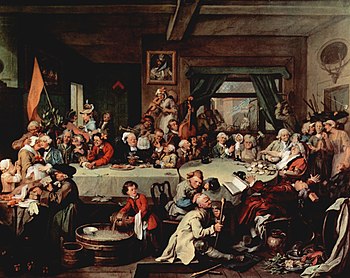
This is Hogarth’s famous painting of a kind of political dinner at a tavern, but this is what the coffee shops would looked like back then.

So if you are trying to come up with new ideas this is the kind of place you need to visit often. We take ideas from other people, people we’ve learned from, people we run into in the coffee shop, and we stitch them together into new forms and we create something new. 

Building upon existing ideas is nothing new.

Artists have been doing it for centuries. Painters draw upon the tools, techniques, and approaches of other painters; musicians build upon the styles of other musicians they have heard; writers are influenced by the books they have read.

Steve Jobs, the cofounder and former CEO of Apple Computer, said in an interview that “the key to creativity is to expose yourself to the best things that humans have done and then to bring those things into what you are doing.” He goes on to say that what made the original Macintosh computer great is that the people working on it were “musicians, and poets, and artists, and zoologists, and historians, who also happened to be the best computer scientists in the world.”

The analogy “trade is to culture as sex is to biology,” from a Wall Street Journal article on the importance of trade in enhancing innovation, captures this concept. According to the article, communities that are at the crossroads of the world, such as ancient Alexandria and Istanbul or modern Hong Kong, London, and New York, which attract people from vastly different cultures, benefit from the cross-pollination of ideas and increased creativity.

What we call distractions, those trivial and time-wasting things might lead to new ideas.

We might want to discard internet surfing or phone browsing as mindless activities with absolutely no result but in fact, they are virtual coffeehouses where ideas are cross-pollinating.

Jan Fortune writes, “Productive people, we learn, are those with their heads down who do one thing well. Whilst there are people who pursue a single passion to great effect, the dictum of the one thing can also be narrowing and separating. Sometimes the price of single-minded productivity to the exclusion of all else is myopia that kills relationships and sacrifices the riches of a multi-disciplinary approach to life.”

Cross-pollination is a marriage between the unlike ideas.

As Suzanne Collins famously claimed in an interview with The NewYork Times that the idea of “The Hunger Games” came to her while flipping channels one night between reality television programs and actual footage of the Iraq War. “On one channel, there’s a group of young people competing for I don’t even know; and on the next, there’s a group of young people fighting in an actual war. I was really tired, and the lines between these stories started to blur in a very unsettling way.”

At that time she was completing the fifth book in The Underland Chronicles, in which she examined the idea of an unjust war developing into a just war because of greed, xenophobia and longstanding hatreds. She wanted to continue to explore writing about the just-war theory for young audiences and wanted a completely new world and a different angle into the just-war debate. And there it was, “The Hunger Games” was conceived,

Creativity is often simple like that.

The novel I’m currently writing started with just one incident that I witnessed as a child. As I wrote one chapter another one surfaced and became the turning point. A five-second scene from a TV serial I watched as a teenaged became the ending.

If you go into the depths of writer’s block, you will find that you need cross-pollination. We get stuck for ideas because we make the mistake of restricting our input sources.

Writers need constant input not only cross-genre but through different mediums.

A lot of people who aspire to be writers use reading the type of books they want to write as their only source of input. Sticking to just your own genera makes you a boring writer.

If you’re serious about becoming a better writer, you’ll put on your headphones, put on a podcast and get some much-wanted exercise. The information that goes into your head through the medium of audio is different from video or text. You may, or may not get time to watch a video or read, but there are at least a dozen opportunities for audio.

Finally, a writing style also requires cross-pollination

When you first start out as a writer, you’re likely to feel like a clone. It is because your manner of writing is either a copy of someone else’s work or some formula you picked up along the way. It feels like you don’t have a personal style. However, your own style is not that far away. And usually, the process is sped up when you cross-pollinate the writers you read and the speakers you listen to.

If you read one writer for a long time, his style becomes a part of you, when you add a second writer, a bit of her style creeps into your being as well and soon a sort of metamorphosis starts to take place. You haven’t changed much consciously, but your work changes a lot.

A style develops when you read or listen to different authors or speakers, drink deeply from one for a while.

When you dig deep into one person’s style, you get an insight that doesn’t come with bouncing around from one author to another. The style needs a bit of monogamy for at least a while before you go out and find another writer to love. Burrow deep into one writer, one speaker for a while and then add the second and the third and possibly the fourth and fifth.

If you do, all you have is overload and your brain doesn’t get the opportunity to tease out the style and structure of the writers and speakers. 

The best part is you don’t have to do much. Your job is to read or listen, not even to necessarily make notes. Over time the brain figures out the patterns, and when you write, you notice the difference. That difference may not be apparent right away, but over time there’s bound to be a clear evolution in your style. 

You may not always have time to watch and read, but there are endless opportunities to listen every single day.

In summary cross-pollination involves reading, watching and listening deliberately in different genre, letting the ideas percolate in you and allowing them to influence your work.

Photo by Richard Sagredo on Unsplash

[mc4wp_form id=”138″]

Generation X your time has come

Bronnie Ware is a hospice nurse from Australia. Her work involves caring for patients who are terminally ill and may pass away within 12 weeks. A few years back, she started recording the dying epiphanies of her patients. She asked her patients if they had any regrets or if they would have done anything differently. And she found a few common themes recurring again and again in all the answers she received.

The number one regret people have is, “I wish I’d had the courage to live a life true to myself, not the life others expected of me.”

Who knows better the price we pay when we succumb to the pressures of life than the generation X.

Remember us, the generation born between 1960 and 1980 (roughly), known as the sandwich-generation. We are cracking under the pressures of raising the millennials (the most demanding generation so far) and parenting the parents (the baby boomers who are living longer and longer)..

Have we missed the opportunity to live our lives forever?

We were the generation raised to change the world. We were to become the leaders, the inventors, the entrepreneurs. Instead, we were bypassed by Generation Y and the Millennials.

At work, our own children became our bosses while we stayed in the 9-5 jobs to keep the steady income flowing. At home, our parents took over our lives while we skipped holidays and cut our social circles to provide care for them.

We lost touch with our dreams. We forgot what we wanted. Life became a drudgery.

Now the first wave of us is reaching the retirement age.

I am one of those. Retirement brings its own challenges. It is supposed to be the time of leisure and fun. But to the on-the-go-all-the-time-Generation-Xer, retirement could be a state of purposelessness. No one needs you. Parents are gone, and children have left. One could go back to work but work becomes suddenly unsatisfying.

But we are still in good health. We need something worthwhile to bring purpose to our lives. We need to get in touch with our dreams.

Retirement is an opportunity to fulfill those forgotten dreams.

We finally have the time and opportunity. Thanks to advancements in medicine and awareness of health, we are going to live at least thirty to fourty years in retirement. That is a hell of a long time to do nothing.

Rather it is a time to do make a real difference. Never before in our lives, were we in a position to do so. You have two to three decades of life experiences to draw from. We don’t have any financial pressure, at least not like when we had big mortgages, school fees and age-care bills.

We have the confidence, enthusiasm and ‘I-don’t-care-what-people-think’ attitude. And we have an amazing network of people around us, who have a different set of skills than us, to help us. And guess what, they are in the same age group as us which means they now have fewer responsibilities and more time to give us a hand if we need it.

Chances are they are also looking for an opportunity to fulfill their potential.

Fellow Generation Xer! your time has come.

Let’s not waste it walking the poodle and weeding the garden. Let’s not use this time to babysit grandchildren.

It is your time. Use it to become the person you always wanted to become. Write that book. Enroll in Artificial Intelligence courses. Invent the next generation of solar engines. Become the entrepreneur you always wanted to become.

Don’t let the age limit your choices. Your choices will help you live a longer and more satisfying life. Don’t let the lack of energy to become your excuse. Your purpose will generate more energy than you need.

Live your life in a way that when you are on your deathbed you don’t have the regret that “I wish I’d had the courage to live my life rather than the life others expected of me.”

[mc4wp_form id=”138″]

Your story is the only legacy you leave behind

Elizabeth Gilbert’s (writer of Eat, Pray and Love) father is a Vietnam veteran. She recently shared a very touching conversation between her father and a woman of his age, who had been a hippie and anti-Vietnam War protestor. The woman said to her father, “I was against the war, but I’m sorry that we didn’t respect your service and your sacrifice back then.”

Elizabeth’s father reached across the table, took this woman’s hand and said, “Thank you for saying that. But here’s the thing — your side was right. The protestors were correct. The Vietnam War was unjust and inhumane. I didn’t know it back then, but I know it now. You were right to protest. You were on the right side of history. Without your protests, the war would’ve gone on even longer.”

The woman said, “But all the same — I thank you for your service.” And Elizabeth’s father said, “And I thank you for your protest.”

Both, Elizabeth’s father and the hippie woman have legacies they will be leaving behind. Their stories.

We too will leave our stories behind, and they will be our legacies more than anything else.

If my story is the legacy I am leaving behind then what is my story?

I have never seen my life as a story before. Things that happened in my life are mundane and commonplace. Choices were made, some by me, some by others for me. I got educated, found a good job, built myself a home. I got married, had kids, raised them like everybody else. Where is the story?

And yet when I look at other people’s lives, I can see their stories.

I can see the story in my parents’ struggle, their commitment to give us a good life and their conviction to their professions. I could see Elizabeth Gilbert’s father’s story. A Vietnam veteran who probably went to war at a very young age, to fight a fight which wasn’t his or even his country’s fight. Yet he put his life on the line not knowing until years later that he was fighting on the wrong side.

I could see the story of the woman protester who, equally young, fought a fight on the streets of her hometown, for a cause that didn’t directly affect her. But it mattered so much to her that she chose to face rubber bullets and water canons to make a difference.

Aaha! therein lies the legacy worth leaving behind.

My parents’ legacy was their struggles to fight the scarcities of life of their era to build a better life for themselves and their children. They did that through the medium of education. Their contribution was the propagation of education not only for their own children but for all the children. They were both teachers.

Elizabeth’s father’s legacy is in knowing that he was on the wrong side of the war, accepting that, rehabilitating himself, and becoming a contributing member of society.

The woman protestor’s legacy lies is raising her voice to help make a change so big that it saved thousands of lives and changed the course of history.

We all have stories.

Our stories lie in the choices we make, the lessons we learn, the things we do.

Most of the time we do these without realising that our choices, our lessons and our actions are going to stay behind long after we are gone.

That realisation itself is powerful. Now that we know what our stories are, we can make better stories. We can make better choices. We can learn more meaningful and deep lessons. We can do things that really matter. So that when we come face to face with our mortality we are ready.

We are not used to preparing for our mortality.

Which is a shame.

Death is as much part of life as birth is. We make so much preparation for the arrival of a new life but we don’t prepare ourselves for leaving this life. By that, I don’t mean leaving behind a will or writing your funeral plan. I mean writing your stories.

Have you recorded what choices you made and what lessons you learned? Have you written down which side you chose in the moment of controversy and which fight you fought to make a change?

Ever since I have entered the second half of my life I have more vigilant of my choices. Although the first half of my life seemed mundane and commonplace it still many stories of choices made and lessons learned.

And now that I know that everything I do will one day become my legacy, I can live the rest of my life to make better stories.

Photo by Toa Heftiba on Unsplash

[mc4wp_form id=”138″]