London – Museums and Art Galleries

London has more than its fair share of museums and art galleries thanks to the British ruling half of the world. The most noteworthy are:
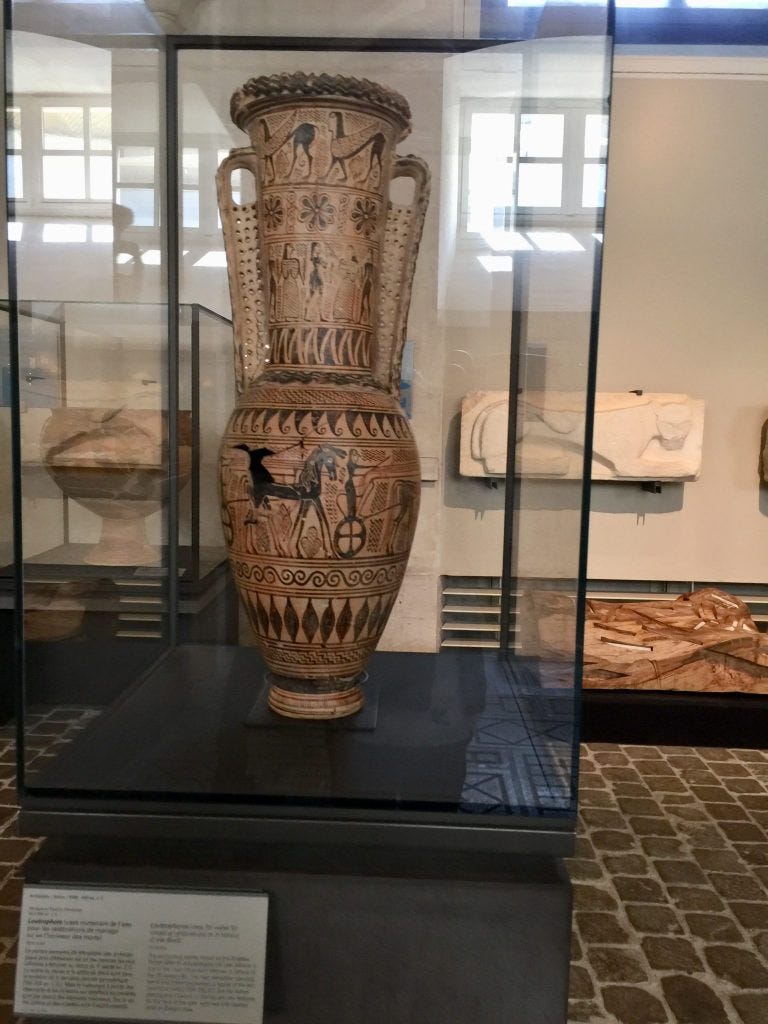
  • The British Museum
  • The National Gallery
  • National Portrait Gallery
  • Victoria and Albert Museum
  • National History Museum
    Science Museum
  • Tate Museum
  • Tate Modern
  • Museum of London
  • Imperial War Museum
  • V&A Museum of Childhood

Out of these, we managed to see four in this visit leaving others for future visits (hopefully!).

The best thing about British museums and galleries is that they are free for everyone. Perhaps the only right thing the British have done, after looting the colonial countries, is not to charge visitors to see their own heritage.

The British Museum

The British Museum has some of the most amazing collections in the world. With seventy galleries and about eight million artifacts, it is one of the largest museums in the world. We decided to keep one full day to visit the British Museum. It is one place where I can spend my whole life without getting bored.

We reached the South entrance of the museum quite early when there was no queue. The first thing that struck me, as soon as I entered the magnificent Greek temple-like entrance with colonnade and pediment was a great open area with lots of natural light.

It was unexpected. With that kind of entrance, I was expecting was an old building and narrow rooms. Instead, The Great Court, as it’s known, had the sun pouring in. The ceiling was exceptionally high and had a glass roof.

I learned later that although the museum is housed in the same building since it was first opened in 1759, it has gone through a number of enhancements particularly in the years leading up to 2000. The Great Court and the South entrance were new additions. The monumental look of the South entrance was designed to reflect the purpose of the building and prepare the visitors for the wondrous objects housed inside.

One Man’s Cabinet of Curiosities Became a Nation’s Museum

The British Museum was established in 1753, from the collection of a single person, an Irish physician and scientist Sir Hans Sloane.

During the course of his lifetime, Sloane gathered a large collection of curiosities. Not wishing to see his collection broken up after death, he bequeathed it to King George II, for the nation, for a sum of £20,000.

At that time, Sloane’s collection consisted of around 71,000 objects of all kinds including some 40,000 printed books, 7,000 manuscripts, extensive natural history specimens including 337 volumes of dried plants, prints, drawings and antiquities from Sudan, Egypt, Greece, Rome, the Ancient Near and the Far East and the Americas.

Its expansion over the following 250 years was largely a result of expanding British colonization. Later on, it resulted in the creation of several branch institutions, the first being the Natural History Museum in 1881.

It was the first public national museum in the world. It documents the story of human culture from its beginnings to the present. It was also the first public building to be electrically lit.

The Rosetta Stone

The most precious object in the museum is the Rosetta Stone. It was the key to unlocking the mysteries of Egyptian hieroglyphics. The Rosetta Stone has inscribed on it a decree passed by Egyptian priests on the first anniversary of the coronation of the Pharoah, Ptolemy V.

The decree is written in hieroglyphics, in demotic or everyday Egyptian of the period, and in Greek. By comparing the three languages on the tablet, scholars were finally able to translate Egyptian hieroglyphics.

How it came to British possession is another story.

The stone was discovered in 1799, during the Napoleonic Wars, by French soldiers digging the foundation of a fortress in El-Rashid. The British acquired it, along with other Egyptian antiquities, under the terms of the Treaty of Alexandria when Napoleon was defeated.

It has been displayed at the British Museum since 1802 except during WWII when it was hidden in a deep tunnel under London.

Easter Island statue

Hoa Hakananai’a – is an original Easter Island ancestor statue, made of basalt.

The name Hoa Hakanania’a means “Stolen or Hidden Friend”. It was probably carved around A.D. 1200.

It was acquired from a ceremonial center in Orongo, Rapa Nui, in 1869 and was presented to Queen Victoria who then gave it to the British Museum.

One of my favorite artifacts is the first library in the world. The last great Assyrian king, Ashurbanipal (reigned 668 – about 630 BC) created the world’s first library (below) to contain all knowledge in his palace Nineveh.

The tablets provide an unparalleled glimpse into the world of Assyria and Babylonia and what came before. Among thousands of tablets were kept some of the greatest works written in Mesopotamia, including the Epic of Gilgamesh.

The king’s library also contained extensive writing on divination, astrology, medicine, and mathematics.

Tablets form the world’s first library
By about 3100 BC documents recording multiple transactions were found over a period of days, months or years involving several cities. New uses were soon found for writing dedications, historical records, literature, and letters. Writing quickly spread to neighboring Iran.
The proper writing began in ancient Iraq. By 3300 BC simply impressed tokens were superseded by a system of pictographic and numeric signs. The first known use of writing was for official book-keeping in city-states like Uruk.

Victoria and Albert Museum

I liked the Victoria and Albert Museum the most. It is massive, has the most varied collection and a lot of information about each exhibit.

It is the world’s largest museum of applied and decorative arts and design, as well as sculptures.

It houses a permanent collection of over 2.27 million objects.

It was founded in 1852 by Prince Albert and his like-minded friends.

The museum was the result of the great foresightedness of Prince Albert whose vision was to educate designers, manufacturers and the public in art and design.

Its origins lie in the Great Exhibition of 1851 – the world’s first international display of design and manufacturing.

Following the Exhibition, its creator and champion, Prince Albert, saw the need to maintain and improve the standards of the British industry to compete in the international marketplace.

The most spectacular area in the museum is the Cast Courts. The Cast Courts were purpose-built in 1873 for the museum’s collection of copies of art and architecture.

At a time when most people could not afford to travel abroad to see important works, it was common for museums to supplement their collections with replicas in plaster. This made the museums a more effective educational resource.

The Cast Courts of the Victoria and Albert Museum have remained relatively unchanged since they were built. The iconic collection at the Victoria and Albert Museum is the biggest collection in the world which includes a copy of Trajan’s Column (shown in two parts because it is too high for the building) and Michelangelo’s David.

Cast replica of Trajan’s Column. Trajan’s Column is a Roman triumphal column in Rome, Italy, that commemorates Roman emperor Trajan’s victory in the Dacian Wars. Cast replica is better preserved than the real one making it very valuable of study purposes,
David by Michelangelo

National Portrait Gallery

The National Portrait Gallery houses a collection of portraits of historically important and famous British people. It was the first portrait gallery in the world when it opened in 1856. It is situated at St Martin’s Place, off Trafalgar Square adjoining the National Gallery.

We spend almost three hours there. Not all the portraits are of exceptional quality but almost all of them are of historical significance. I particularly liked the following three portraits of Queen Elizabeth 1, Mary the Queen of Scott’s and Malala Yousafzai (an activist for female education).

Queen Elizabeth I This painting is the most important surviving image of the queen. It was almost certainly painted from life. The facial likeness was traced and reused in many later portraits of Elizabeth.
Mary, Queen of Scots
This photograph of Malala Yousafzai (an activist for female education) has a handwritten (calligraphy) poem of a Pashto poet Rahmat Shah Sayel from Peshawar.

I already wrote about The National Gallery in my post Buckingham Palace, Trafalgar Square, and the National Gallery.

Did you like the post? Did anything the post surprise you?  Would you like me to write more about the museum and galleries I visited? 

Let me know through the comments section.

Edinburgh – The Writer’s Museum

Edinburgh is perhaps the only city in the world with a huge monument and a museum dedicated to its writers.

Home to many famous writers — Robert Burns (1759–1996), Sir Walter Scott (1771–1832), Robert Louis Stevenson (1850–1894), and Sir Arthur Conon Doyle, to name a few — the city has more than its fair share of literary giants.

When you approach the city, no matter in which direction you come from, the first thing that catches your eye is a Gothic-style building looming high in the skyline. I thought was an old chapel. As we got closer, it turned out to be a memorial build to honor the city’s favorite son and noted writer Sir Walter Scott.

It is the biggest monument ever erected for a writer anywhere in the world.

If that wasn’t enough to excite me, the next day, I found out that Edinburgh also has a Writer’s Museum. Needless to say, I wanted to visit it. It is not easy to locate by, my daughter found using her superior skills with iPhone. It is housed in Lady Stair’s House in the older part of the town near Edinburgh castle. 

Once a grand mansion near the Royal Mile, the Lady Stair’s House is a four hundred years old, multi-story building. The story is that in the 19th century, when the old buildings were being demolished, a conscientious town planner embarked upon an ambitious renewal program. 

Lady Stair’s House was about to be demolished when the fifth Earl of Rosebery (1895) bought the mansion and gifted it to the city of Edinburgh for use as a museum.

The mansion has gone through many renovations since then and has a writerly ambiance to it. 

Tiles with quotes on the way to the Writer’s Museum

Though not very big, the museum has enough to entice the literary kind. 

It had three distinct areas, one dedicated to each of the three famous writers.

 Each area has a display of some artifacts from writers’ lives, their stories depicted by banners and photographs, and excerpts from their writings.

Robert Burns

Robert Burns was a poet, a romantic kind, who was famous with ladies. He is regarded as a pioneer of the romantic movement in English literature.

He later became a great inspiration to liberalism and socialism. His most famous poem is To a Mouse.

In his later life, he collected Scotland’s folk songs and wrote many of them himself, which are still sung in pubs around Scotland.

Some of his famous poems and songs of Burns that remain well known across the world today include A Red, Red Rose, A Man’s a Man for A’ That, To a Louse, The Battle of Sherramuir, Tam o’ Shanter, and Ae Fond Kiss.

Sir Walter Scott

Sir Walter Scott was a historical novelist, poet, playwright, and historian. Many of his works remain classics of both English and Scottish literature. Famous titles include Ivanhoe, Rob Roy, Old Mortality, The Lady of the Lake, Waverley, The Heart of Midlothian, and The Bride of Lammermoor.

Robert Louis Stevenson

Robert Louis Stevenson was a novelist and travel writer, most noted for Treasure Island, Kidnapped, Strange Case of Dr. Jekyll and Mr. Hyde, and A Child’s Garden of Verses.

Arthur Conan Doyle

Arthur Conan Doyle, the creator of Sherlock Holmes character, though was not born in Edinburgh but was educated at the University of Edinburgh. 

A café in 71 -73 York Pl, claims that the famous writer used to live close by.

Alexander Graham Bell

Another notable person born in Edinburgh was scientist, inventor, engineer, and innovator Alexander Graham Bell. 

Alexander Bell’s most notable invention was the telephone.

Needless to say, I had a field day in Edinburgh.

Edinburgh – the tale of two cities

On Saturday morning, we left Glencoe for Edinburgh. It had been raining all day on Friday, ending our lucky spell of eight days of perfect sunshine. Rain just stopped long enough in the morning for us to put our luggage in the car and take a few photos of the surrounding hills.

The drive to Edinburgh was beautiful. As soon as we left Glencoe, we were greeted by lush green valleys, hills with countless waterfalls, and green-carpeted pastures dotted with white sheep. At one place, water was gushing out from the earth, a natural spring. At other places, lakes would appear out of nowhere.

There were several stops to admire the view, but we resisted at most of them. The car we hired was due for return at mid-day, and if we stopped frequently, we wouldn’t have made it in time.

At Edinburgh, we deposited our luggage at the bus stop locker and went on to find a petrol station to fill the car. The Google map took us around the whole city but couldn’t get us to a petrol station. Finally, half an hour later, we spotted one.

After returning the car we made out way to a café close to our accommodation and had coffee and the best salad on the whole trip.

The accommodation we were staying at was our first ever Airbnb. It turned out to be a great choice. Walking distance from the city center, Calton Hill and many good restaurants it had sunny rooms and a good selection of books.

After resting for a little while, we went on to explore the city. It seemed like the tourists had invaded the city. Where ever we went, there were crowds.

We walked up the Royal Mile, which had Holyrood palace on one end and the fortress of Edinburgh Castle on the other. 

Totally a touristy place, the Royal Mile had bagpipers playing and street artists performing all the way to the Edinburgh castle. The platform was being prepared in front of the castle for a military parade of some kind.

Signboards told us that it was the site of execution for hundreds of women charged for practicing witchcraft.

Edinburgh Castle

I was not too much off the mark in thinking that Edinburgh architecture is both enchanting and striking at the same time. The Little Book of Edinburgh, which I found in the bookshelf of our accommodation, had the following account on the very first page.

It is spectacularly beautiful, combining a dramatic natural landscape of hills, valleys and the cone of an extinct volcano with an architectural heritage so glorious that it has more listed buildings than anywhere in the UK outside London.

At the same time, there is grimness to the place, a secret, gritty history of dark deeds and squalor. It is this combination – beauty and the beast, if you like – that makes Edinburgh so utterly fascinating, so beguiling.

One of Edinburgh’s most famous sons, Robert Louis Stevenson, knew this better than anyone. His novel Dr. Jekyll and Mr. Hyde, about two conflicting personalities inhabiting the same body, is a virtual metaphor for his native city. Edinburgh is a ‘tale of two cities or rather many different tales. – Geoff Holder, The Little Book of Edinburgh

In the evening, we went up the Calton Hill. Calton Hill, together with Arthur’s Seat and Castle Rock, was formed by volcanic activity about 340 million years ago. Around two and a half million years ago the first of many Ice Ages began in Scotland and Edinburgh was buried under a massive ice sheet, hundreds of meters thick. Throughout each Ice Age when the glaciers were at their heaviest, the weight of ice carved and gouged out many of the hills we see today. 

Calton Hill has a very interesting history. In 1724, the Town Council of Edinburgh purchased Calton Hill making it one of Britain’s first public parks. It has monuments and buildings dating back from 1760 to 1820 relating to the period known as ‘Scottish Enlightenment,’ a time of great artistic, literary and scientific advances. 

One of the leading figures of the Enlightenment was the philosopher David Hume. In fact, he was responsible for lobbying the Town Council to build public walks or roads for the health and amusement of the inhabitants on Calton Hill.

Calton Hill houses a number of buildings including the Scottish National Monument, Nelson Monument, and an Observatory.

Scottish National Monument

Scottish National Monument was intended to be another Parthenon and to commemorate Scottish Soldiers killed in the Napoleonic wars. Its construction started in 1826 but was stopped in 1829 when the building was only partially built due to lack of money. It has never been completed. 

For many years this failure to complete led to its being nicknamed “Scotland’s Disgrace” but this name has waned given the time elapsed since the Napoleonic Wars and it is now accepted for what it is.

Nelson Monument

Nelson monument is the most interesting building I have ever seen. Build to commemorate the victory of Vice-Admiral Horatio Nelson, over the French and Spanish fleets at the Battle of Trafalgar in 1805, the tower has a time ball on it.

A wooden mechanized ball was added at the top of the telescope-like building to give a time signal to ships in Leith harbor. It was a great idea until they realized that the ball is not visible on a foggy day.

This led to starting another time signal tradition — firing an 18-pound loaded canon known as ‘one o’clock gun.’

The time ball is synchronized with the One O’Clocks firing from Edinburgh Castle.

Neither the gun nor the time ball is needed by the ships today but both still sound every day telling the Edinburgh people it is lunchtime.

Observatory House

Calton Hill Observatory is considered the birthplace of astronomy and timekeeping.

The Observatory houses a refractor in its dome and a 6.4-inch transit telescope for astronomical and naval observatories to measure star positions in order to compile nautical almanacs for use by mariners for celestial navigation. 

The telescope is used to observe star transits to set extremely accurate clocks (astronomical regulators) which were used to set marine chronometers carried on ships to determine longitude, and as primary time standards before atomic clocks. (Source: Wikipedia).

Arthur’s Seat

The next morning we started the day by climbing Arthur’s Seat. As the main peak of a group of hills made from an ancient volcano Arthur’s Seat has panoramic views of the city. 

It was relatively easy to climb except for the top part which was slippery, rocky, and spiky. Needing a bit of challenge for the day, I decided to go to the top and have my photo taken. 

Arthur’s Seat — Images by the author

Holyrood Palace

Just next to Arthur Hill is Holyrood Palace which the official residence of the Queen when she visits Scotland. It has been the principal royal residence of the Scottish monarch since the 16th century and used for state occasions and official entertaining.

The Queen spends one week at Holyroodhouse at the beginning of each summer and throws a lot of parties in the lovely gardens. 

The inside of the palace is open to the public throughout the year and is very interesting. We watched the 16th-century historic apartments of Mary, the Queen of Scotts including the chamber where her private secretary David Rizzio ware murdered.

Also worth mentioning are the ruins of the Augustinian Holyrood Abbey, which was founded in 1128 at the order of King David I of Scotland. It is a burial site of many kings.

Holyrood Palace — Images by the author

We spent the last day in Edinburgh roaming the streets, visiting the Edinburgh museum and art gallery, and having a wonderful breakfast at a local cafe. 

For dinner, one night we went to a Turkish restaurant which had the most sumptuous kabab platter I have ever had.  

Edinburgh streets — Images by the author

This is part 7 of the 13 part series. If you want to read the previous article of this series, here are the links:

Inverness And The Monster Of The Loch Ness

Windsor Castle, Bath, and the Stonehenge

Buckingham Palace, Trafalgar Square, and the National Gallery

The London Eye, Palace of Westminster, and Westminster Abbey

Buckingham Palace, Trafalgar Square, and the National Gallery

Tower of London and St Paul’s Cathedral

London — The First Impression

Inverness and the monster of the Loch Ness

No visit to the UK is complete without visiting the Highlands and Inverness. Inverness is the capital of the Highlands.

Most people start their trip to the Highlands from Edinburgh and work their way up towards Inverness, but we did it the other way around. We caught a flight from London to Inverness and worked our way down towards Edinburgh. Yesterday I wrote about Edinburgh, today I am going to write about two nights we spent in Inverness.

We caught 9:45 flight from London to Inverness and got there around 10:45. We had booked a car which turned out to be the best decision since most of the must see places are at considerable distances.

Inverness

As soon as we drove out of Inverness airport, we were greeted by the beauty of the Highlands. We drove past the tree-lined road for half a mile which opened up to perfectly carpeted valleys and hills in the freshest of green. Taking out a camera to capture the view in the picture would be insulting to the scenery so beautiful, so I just watched and took it all in.

Thanks to Google maps, we found our way to our Bed and Breakfast place without any problem. We deposited our luggage with the friendly landlady, who also guided us on where to eat and what to see on an exceptionally sunny day.

Our room at B&B

Tourism seems to be the main source of income for the town as almost every second house in Inverness was a Bed and Breakfast. No wonder we had to pay premium rates for our room as every place had a No Vacancy sign-on.

It was a perfect day; sunny, mild, and without any wind, so we had a quick bite to eat and went on to see Loch Ness.

Loch Ness and its monster

Loch Ness is a large, deep freshwater lake on the southwest of Inverness. It is the second-largest Scottish loch, but due to its great depth, it is the largest by volume. It is said to be able to drown the whole population of the world three times over. Its deepest point is 230 m which is little more than the tallest building in London (The Shard).

Loch Ness

Loch Ness is best known for alleged sightings of the cryptozoological Loch Ness Monster.

The Loch Ness Exhibition Centre has a dramatic exhibition to tell the monster’s story, which has been around for hundreds of years and was first brought to the world’s attention in 1933.

The Loch Ness Monster, or Nessie as it is called, is said to be a large creature with a long neck and one or more humps. Although evidence of its existence is anecdotal, millions of dollars have been spent to find proof for its existence but the finding are still inconclusive.

Whether the monster exists or not, the legend is good for local business. Thousands of tourists flock to the Exhibition Centre (built in 1980 and now a winner as a 5-star visitor attraction by the Scottish Tourist Board), including wide-eyed children and their equally amazed parents and grandparents who probably want to keep the legend alive.

The town of Drumnadrochit

Drumnadrochit is a small but lovely village on the western shore of Loch Ness. We stopped there to have a little walk to stretch our legs and then have a coffee from Fiddlers Highland Restaurant, a must for the visitors to the town.

Town of Drumnadrochit
Fiddler’s at Drumnadrochit

Divach Falls

We took a small detour to see Divach falls which were just 2 miles up a single track, and then a short walk through the densely populated forest. The falls were small, but the walk through the tress was beautiful.

Walk to Divach Falls
Divach Falls

Urquhart Castle

On the way back to Inverness, we stopped by Urquhart Castle. It sits beside Loch Ness, just 2 kilometers east of the village of Drumnadrochit. It is just a ruin now and is said to date from the 13th to the 16th centuries, though built on an early medieval fortification site.

It was almost half-past five when we arrived there. Entry to the castle was closed. We took some pictures and left for Inverness. Before dinner, we took a short stroll beside River Ness while it was still light.

Urquhart Castle

Inverness Castle

If yesterday was the perfect day to see the Loch Ness and Divach Falls, today was the perfect day to see the Inverness Museum and Art Gallery as it had been raining all morning. The Inverness Museum and Art Gallery have an impressive collection divided into geological, cultural, historical, and art sections. We spent a good two hours there reading about the formation of Highlands 135 million years ago. We learned about the proud traditions of Highlanders, how they lived, the instruments they played, and the clothes they wore.

I always prefer visiting small museums and art galleries as I tend to spend more time absorbing a limited number of exhibits. I come out feeling less overwhelmed and more informed than after visiting large museums and galleries with endless displays.

Next to the Inverness museum is Inverness Castle which sits on a cliff overlooking River Ness. It is a red sandstone structure, built in 1836 by architect William Burn as an 11th-century defensive structure. Unfortunately, we couldn’t go inside it as it houses the Inverness Sheriff Court.

Inverness Castle

Culloden Battlefields

Twenty miles to the north of Inverness, towards the direction of the airport, is the Culloden battlefields where the final battle of Jacobite Rising was fought (16 April 1746) to restore the Stuart monarchy to the British thrones. It was the last battle, and in less than an hour, around 1,500 men were slain — more than 1,000 of them Jacobites.

An interactive visitor center is built on the site to tell the story of these brave men. It was a real eerie experience to walk in the vast ground listening to the wind and imagining what would have happened there more than three hundred years ago.

There is a small memorial tower in the middle of the battlefield and a hut on the side that has been there since the battle.

Stone memorial on Culloden Battlefields
Original hut on the outskirts of Culloden Battlefields

A visit to a distillery

It was still raining when we left the Culloden Battlefields. So rather than going back to the B&B, we decided to visit the nearby Tomatin distillery detour of twenty miles.

Those twenty miles became forty miles as we missed the turn, and Google Maps took us to through windy country roads. Rather than regretting it, we thoroughly enjoyed the drive as it was the most beautiful drive so far. We spotted a Viaduct bridge which was perhaps bigger than the Glenfinnan bridge made famous by the Harry Potter movies.

It started pouring when we reached the Tomatin distillery. We made our way to the reception desk only to find that the distillery tours were fully booked. We needed to book many days in advance due to the busy season.

The friendly but extremely busy staff offered us a free whisky tasting and turned on the movie for just the two of us.

Tomatin Distillery

We had dinner at the Caledonia pub and called it a night. The next day we were to drive to Glencoe, indisputably most beautiful place in the Highlands, as the friendly landlady told me.

Do you have any stories to share about the Highlands? I would love to hear them. Share them with me through the comments section, please.

This is part 6 of the 13 part series. If you want to read the previous article of this series, here are the links:

Windsor Castle, Bath, and the Stonehenge

Buckingham Palace, Trafalgar Square, and the National Gallery

The London Eye, Palace of Westminster, and Westminster Abbey

Buckingham Palace, Trafalgar Square, and the National Gallery

Tower of London and St Paul’s Cathedral

London — The First Impression

Windsor Castle, Bath and the Stonehenge

We took a day tour to see Windsor Castle, Bath, and Stonehenge. They were all in the same direction.

The tour bus (or coach as the Londoners call it) started near Victoria station. We were expected to arrive there at 7:45. So paranoid were we being late that we got there at 7:00 AM. What to do?

We decided to roam around and see if anything was open. We started aimlessly in one direction and soon found ourselves in Victoria Street, lined by boutique stores. What was surprising that every shopfront was decorated with flowers, which I was told later, was to mark the Chelsea Flower festival, a big event in the London calendar. Unfortunately, the flower festival had already finished before we arrived in London, but the street decoration provided a perfect setting for photos.

Victoria Street endured extensive bombing during 1940–1941 and was again damaged in the flying bomb campaign of 1944–1945. However, it was redeveloped in 1851 to replace Westminster’s notorious slum housing acres.

We took some photos and walked back in time to board the coach. The drive to Windsor was beautiful. We had our first glimpse of the countryside, and it didn’t disappoint. Fields stretched for miles in lush green. Sky much lower than in London. Clouds scattered here and there, giving it all a magical enchanting the first-time traveler to this beautiful country.

A view of the fields while driving to Bath
Lush green countryside outside London

Windsor Castle

Our coach was one of the first few to arrive at the Windsor castle. The tourists from at least two other coaches were already lining up outside the castle gates, which would not open for another half an hour.

We stood in the line while our guide filled us with the history of the castle. It was built by William the Conqueror in the 11th century simultaneously as the Tower of London. Later monarchs extended it and turned it into a luxurious palace, especially Edward III, who modeled it on Paris’s Versailles. Since the time of Henry I, the place has been used by the reigning monarch, making it the longest-occupied palace in Europe.

After an airport-like security check, we were handed an audio device each and let loose inside the castle, which is weekend home to the Queen. It had a magnificent entry hall which is regularly used to receive dignitaries. The set of rooms that followed were getting increasingly impressive with original wall paintings and tapestries.

In 1992, the castle had a huge fire, which burnt most of the rooms except the three interior rooms, which still have the original furnishing since the times of King Charles I. Thanks to the staff’s commitment, all items of historical significance were saved except three — a large wall panel, a dresser, and a painting — which were too large to be moved.

Each day at 11:00 am, the change of guards ceremony occurs at the Lower Ward of the castle near the St George’s Chapel, which we had the privilege to watch from a close distance. Having missed the change of guards at Buckingham Palace, this was a real treat.

The most impressive place in the castle is the St George’s Chapel, where at least fifteen monarchs are buried, including King Henry VIII, King George IV, Queen Elizabeth II’s mother, and her sister Margret. This is the most likely place the current queen might choose as her final resting place beside her father, mother, and sister. It is also the chapel where Prince Henry and Megan got married.

Build in the Gothic style, it is under the direct jurisdiction of the monarch and is the Chapel of the Order of the Garter.

The Order of the Garter has an interesting history as well, something I did not know of since this visit. It is the highest order of chivalry founded by King Edward III in 1348. It is the most senior order of knighthood in the British honors system, outranked in precedence only by the Victoria Cross and the George Cross. Appointments are made at the Sovereign’s sole discretion. Membership of the Order is limited to the Sovereign, the Prince of Wales, and no more than 24 living members or Companions.

Bath

We drove to an old town of Bath from Windsor Castle, famous for its exquisite architecture and Roman Baths.

Bath has the only natural thermal hot springs in Britain you can bathe in. When Romans found out about them, they turned the place into a spiritual and healing destination by building a colossus structure over a rectangular pool for swimming and several saunas, massage, and other therapy rooms, many of which have still survived.

The place was a delight to visit, despite many visitors because of how information was presented as small movie clips played on the walls and floor of the ruins depicting how Roman might have used the facility.

A lady dressed as Roman aristocrat

They say the whole bath was built by the stone from a single query. Maybe that is the reason or maybe good town planning, but the Bath streets have appealing symmetry about them.

A street in Bath showing the architecture
Bath Abbey, an exquisite piece of architecture
Bath gardens

Two things one must do at Bath, taste the water from the hot water spring and then have icecream to kill the taste.

We did that and left Bath around 4:00 pm for Stonehenge. It was still bright and sunny. Sun was not going to go down till ten pm Who said weather is horrible in Britain?

Stonehenge

British are very proud of their Stonehge – more than 5,500 years-old, built by Neolithic people – it is perhaps the oldest prehistoric monument in Europe.

Each year it attracts millions of tourist. The monument itself is in the middle of pastures and about three mile walk from the visitor centre where the bus dropped us. We had just an hour to spend there so we decided to take a free bus to actual rocks. Some daring souls decided to walk.

The rocks were smaller than I thought (4 m by 2.1 m) nonetheless their alignment very impressive considering everything was done using simple tools and technologies. Although the monument is believed to be related to death somehow I believe it was a testament to shear human single mindedness.

There is a very impressive exhibition in the visitor centre next to the Stonehenge which has hundreds of archaeological objects discovered in the landscape telling the story of the people who used to live here. The centre also has replicas of Neolithic houses with thatched roofs for children to explore and live model of how stones weighting more than 25 tones were brought to the site from hundreds of miles away.

Best place to learn more about Stonehenge is this BBC documentary.

We had 35 minutes to spare so decided to walk back to the centre. It was so serene and quiet. We could hear occasional sound from a lark and in spite of the fact there were so many visitors I could still hear the silence. It was not hard to understand why people who lived here chose this place to burry their dead. On the drive back to London we saw several burial mounds.

With 360 degree view of the landscape, Stonehenge became my favorite place in Britain so far.

Stonehenge
Direction for mid winter sunset
Direction for mid summer sunset
Columns and rocks on the top
Walk back from Stonehenge

Have you visited any of the places in this post? 

Do you have any stories to share? I would like to hear about your experiences. 

Drop me a line in the comments section below.

The next post — Inverness and the Monster of the Loch Ness

This is article 5 of the 13 part series. If you want to read the previous article of this series, here are the links:

The London Eye, Palace of Westminster, and Westminster Abbey

Buckingham Palace, Trafalgar Square, and the National Gallery

Tower of London and St Paul’s Cathedral

London — The First Impression

The London Eye, Palace of Westminster and Westminster Abbey

No visit to London is complete without a ride on the London Eye, the world’s tallest cantilevered (anchored on one side only) wheel which takes you 135 meters above the ground and gives you a 360-degree view of the city.

But getting on the wheel is not easy. Lines run miles long especially during summers and school holidays. We left home early and were in the queue by half-past nine. Luckily we got our tickets within half an hour and were in the queue to get in the capsule for less than an hour.

Before getting on the wheel we watched the London Eye 4D movie, a multi-sensory, four-minute show which brings the city to life through video and special effects including bubbles and scents.

Opened in 2000, the London Eye was going to be a temporary attraction to mark the Millennium but was so successful that it was granted a permanent permit. A figure released in June 2008 revealed that thirty million people had ridden it since the day it was opened. More recently an estimated 3.75 million visitors ride it every year.

It took us less than half an hour to complete the circle. Although I am not scared of heights, going that high up in a glass capsule was still a big ask. My biggest worry was that the capsule will shake with the wind at the top. But it didn’t. It was fixed. The ride was even easier than some of the suspension bridges I have crossed which shook violently when I got in the middle. The ride was smooth and I was totally engrossed in the unfolding scenery around me particularly of the various bridges, Big Ben, the House of Parliament, St Paul’s Cathedral, Piccadilly Circus, and Buckingham Palace.

View of the Palace of Westminster and Big Ben from the London Eye

Sir Richard Rogers, the winner of the 2007 Pritzker Architecture Prize, wrote of the London Eye:

The Eye has done for London what the Eiffel Tower did for Paris, which is to give it a symbol and to let people climb above the city and look back down on it. Not just specialists or rich people, but everybody. That’s the beauty of it: it is public and accessible, and it is in a great position at the heart of London.

– Sir Richard Rogers
Right at the top on the London Eye

We walked the Jubilee Bridge to go to the Northbank. We could have taken the Westminster Bridge but on his last trip to London, Jubilee Bridge was the first one my husband walked across and really liked it and he wanted to walk across it again.

Jubilee Bridge from London Eye

The Thames, London’s main river, has many bridges across it and you can get a good view of some of those from the London Eye. I found a very nice painting in a souvenir shop which gives an aerial view of at least ten of them.

A painting for bridges across the Thames

Big Ben and the House of Parliament

We walked past the Whitehall gardens and got to Big Ben which was covered by scaffolding. Pity, it was going through renovations and we couldn’t see it in its full glory.

I was really surprised by how many London buildings have clocks on them. In the times when people didn’t have their own clocks and wristwatches, they used to drive people’s lives. Perhaps English punctuality can be attributed to them.

Whitehall Gardens

Crowds were moving towards Parliament Square, a small clear area surrounded by many important buildings, and we went with the flow. Once in the square, we sat down for a while to get our bearings. In front of us was an impressive Gothic building, once the Palace of Westminster and now the Parliament House. On the right was the Westminster Abbey and on the left were Government Offices of Great George Street.

The parliament square is where a number of protests are held. It has numerous statutes of politicians on its grounds, Churchill, Benjamin Disraeli, Sir Robert Peel, Abraham Lincoln, Nelson Mandala, and Gandhi to name a few. It is really a lovely place to sit and take in the surroundings.

Statue of Churchill in the Parliament Square

After having something to eat we gathered our backpacks and jumped into the sea of tourists to have a closer look at the Palace of Westminster.

The initial royal palace was constructed in the 11th century and was the primary residence of the English monarchy since then. In 1512 it was destroyed by a fire. After that, since the 13th century, it served as the home of the Parliament of England and also as the seat of the Royal Courts of Justice. In 1834 an even greater fire ravaged the heavily rebuilt House of Parliament and the only significant medieval structures to survive were Westminster Hall. It has since been rebuilt.

We walked around the complex admiring the architecture of the buildings and mastery of the people who have skillfully carved almost every surface. It was breathtakingly beautiful. I regretted not pre-booking an inside tour. It is something I would like to do on my next visit.

One of the buildings at the Palace of Westminster
One of the entrances to the Palace of Westminster through a wire mesh.

Westminster Abbey was just next to the House of Parliament and was one of the most impressive buildings I have ever seen. It has a legendary status in the English monarchy. Founded by Edward the Confessor, it is the church where all the monarchs have been crowned since 1066. Not only that it has 3,300 tombs on its grounds including King Henry VII, Elizabeth I, and Isaacs Newton.

But most importantly it is the church for royal weddings, particularly of crown princes. Prince William and Kate Middleton got married here and so did Prince Charles and Princess Diana. Even the current Queen Elizabeth II and Prince Phillip got married here. In fact, there have been 16 Royal weddings here, the first one being of King Henry I and Matilda of Scotland in 1100.

Westminster Abbey

We returned to Parliament Square and we could hear music playing at some distance. Walking in that direction we reached Hyde Park where some very enthusiastic young musicians were playing African drums. A lot of people were gathered there listening to the energetic beats and enjoying the perfect day in the sun.

It has been a perfect morning so far. We walked from there passing the Churchill’s War Rooms and Horse Guards Parade which is a large parade ground for annual ceremonies. It was being prepared for the Trooping the Colour ceremony. We went to Trafalgar Square where we had lunch and prepared ourselves to tackle the National Portrait Gallery which I will write about in my next post.

What has been your experience of the London Eye? Have you been inside the House of Parliament or Westminster Abbey? 

Have you got any stories to share about today’s post? I would like to hear them. 

Drop me a line through the comment section.

The next post — Windsor Castle, Bath, and the Stonehenge